Quiz Entry - updated: 2026.10.15
Which three levels of digital sovereignty can be distinguished, and what does each one mean?
- State: autonomy and security of the national infrastructure.
- Companies: economic autonomy and competition against foreign tech providers.
- Individuals: the citizen's ability to act and decide consciously and independently.
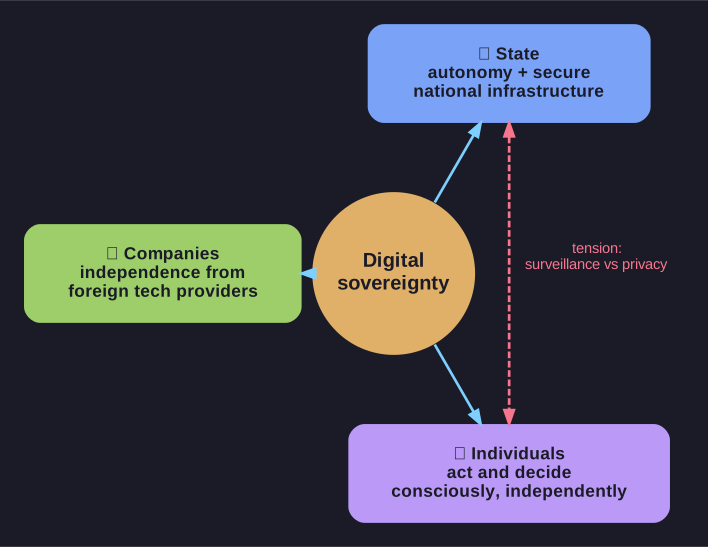
* State, companies and individuals, with the tension between state and individual *
Classically, sovereignty means a state's independence from other states (external sovereignty) and its supreme authority over all powers within its territory (internal sovereignty). Claims to digital sovereignty can be sorted by whose digital self-determination they are about.
- State autonomy and infrastructure security. This has been the core of the debate since the Snowden revelations (2013). The fear is a re-territorialisation of the internet: fragmentation into national segments, with heavy economic and political costs from digital and geographic isolation.
- Economic autonomy and competition. The national economy's independence from foreign (mostly US, increasingly Chinese) providers. Unlike level 1, it is usually part of a wider industrial strategy. Example: a retailer on Amazon or an app developer on Apple loses its distribution channels, its direct customer contact and its customer data, and has to pay high fees.
- Individuals. The autonomy of citizens as employees, consumers and users (empowerment, self-determination). This level breaks with the state-centred view: sovereignty is not authority over a territory but the individual's capacity to act and decide consciously, deliberately and independently.
Tip: state, economy, individual: the same three actors as in the "who regulates whom" question.
Go deeper:
 Pohle & Thiel (2020): Digital sovereignty, Internet Policy Review — open-access paper behind the three-level distinction.
- Wikipedia: Splinternet — what a re-territorialised, fragmented internet looks like.