Question
What does the Black Mirror episode Smithereens say about digital platforms and responsibility?
Answer
It presents smartphones and social networks not as neutral tools but as manipulative systems that exploit the human need for approval for commercial gain, so that individual guilt and corporate responsibility become inseparably tangled.
In the episode, a ride-share driver takes an employee of the social network Smithereens hostage. He wants to speak to its founder, because he blames himself for a fatal crash he caused while checking his phone. The themes:
- the addictive potential of digital platforms
- the loss of human closeness
- the moral responsibility of tech companies
- the tension between the attention economy (profit from keeping users looking) and human agency
- communication reduced to superficial images and symbols
The core ethical point: if a product is built to capture attention, the user who gets captured is not the only one responsible for what follows.
Go deeper:
 Wikipedia: Smithereens (Black Mirror) — plot and reception of the episode.
Note saved — thanks!
Question
From an ethical perspective, how can games affect a person's duties and their chances of a good life?
Answer
Games can teach skills and create friendships, but they can also lead people to neglect duties such as health. Their faster rewards can pull players out of reality until they value virtual success as highly as real success or more, and an addicted player loses autonomy.
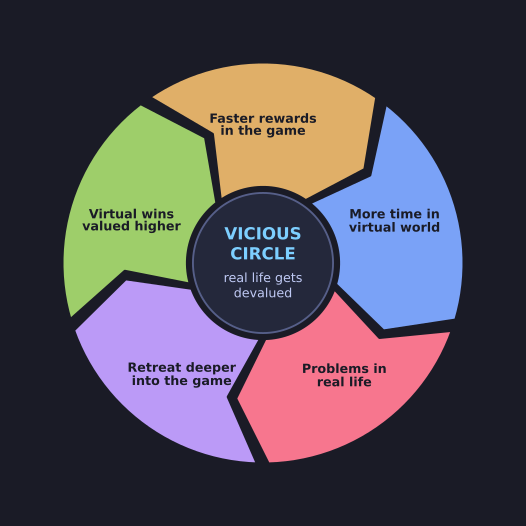
* Faster rewards pull players in, real-life problems push them further in *
Duties (Klemm & Pieters 2017):
- Positive: players can learn new skills and make friends.
- Negative: health may be neglected; skills from the virtual world may not transfer to the real one; the difference between real and simulated values may become unrecognisable.
- The transfer claim is disputed. Strategic thinking, problem-solving, communication under stress and English skills often do carry over into IT work. It depends on the game and the context.
The good life (happiness and a long life):
- Games may offer faster rewards than real life, so players spend more time in the virtual world.
- The resulting problems (e.g. at school) push them further into the game.
- They start to rate virtual success equal to or above real success, which devalues real life further. It is a vicious circle.
- Addicted players suffer from a loss of autonomy: they no longer control their gaming habits and find it hard to stop even when they see the harm.
Go deeper:
- Klemm & Pieters (2017): Game mechanics and technological mediation — open-access paper behind the duties and good-life analysis.
- Wikipedia: Video game addiction — the clinical debate around gaming disorder.
Note saved — thanks!