Why might strictly minimising injuries mean systematically protecting women and older people at the expense of others?
Because crash-injury risk is not the same for everyone — and a rule that minimises expected injuries must, given that data, steer collisions towards the more resilient bodies.
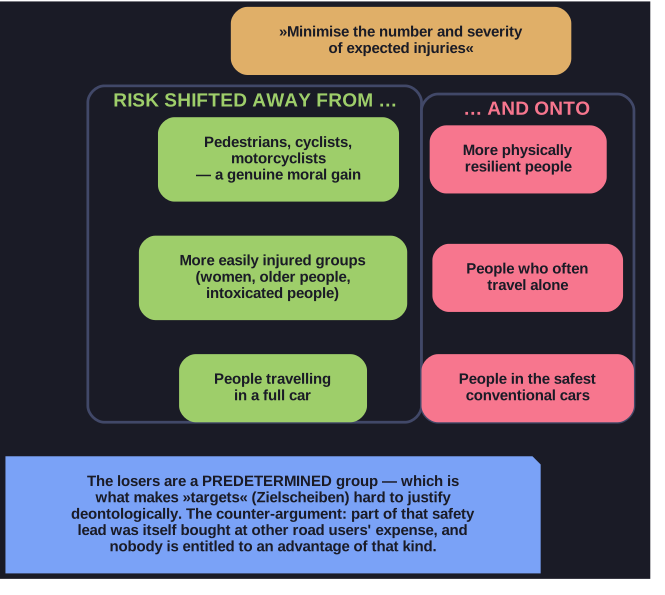
* The rule values nobody more highly — it follows injury data, and that is what makes the losers predictable *
Studies show that different groups of people are endangered to different degrees in accidents — women, older people and intoxicated people among them, who suffer more severe injuries from the same physical impact.
A programming aimed strictly at minimising injuries must take that data seriously, and the implication is uncomfortable: it would have to prioritise the protection of women over men, and of older adults over younger ones. Not because it valued them more, but precisely because they are more easily harmed, so the expected-injury total falls when the collision is steered towards the more resilient party.
The consequence stated plainly: the interests of particular, predetermined groups would be systematically sacrificed in order to protect the interests of other, more vulnerable groups. A system that automatically makes certain population groups into "targets" (Zielscheiben) whenever an accident becomes unavoidable would be hard to justify from a deontological standpoint.
And note what this does to the earlier defence. The vaccination analogy worked because the identity of the person harmed was unknown at the time of the decision. Here it is not fully unknown: a healthy young man knows in advance that the rule assigns him more risk, on the basis of a group characteristic he cannot change. The decision is still taken behind a partial veil, but the veil has holes in it — and the holes are exactly the categories that anti-discrimination law exists to protect.
Go deeper:
 Wikipedia: Non-motorist (vulnerable road user) — why pedestrians, cyclists and motorcyclists dominate any expected-injury calculation.