Why does an LED need a series resistor, and how do you pick its value?
Without a resistor nothing limits the current, so the LED and possibly the pin burn out. Choose R = (supply voltage − LED forward voltage) ÷ desired current, from Ohm's law V = I · R.
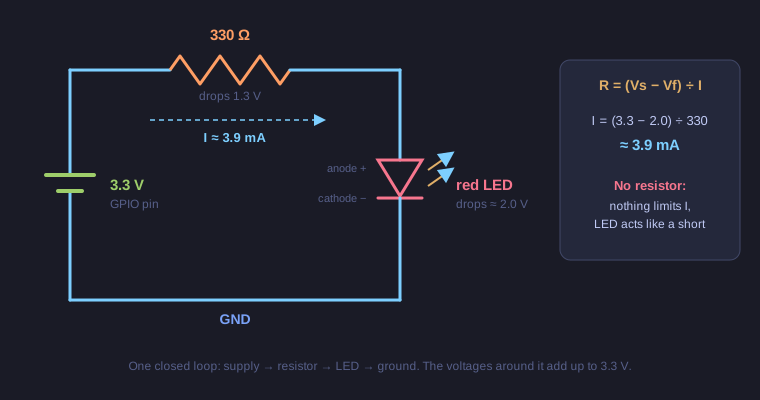
* The resistor takes up the voltage the LED doesn't, which fixes the current. *
An LED is not a resistor. Once the voltage across it reaches its forward voltage (about 2 V for red, about 3 V for blue or white), it conducts almost freely, so a small extra voltage causes a huge rise in current. Connected straight across a supply, it acts close to a short circuit: the current spikes and the LED overheats. That is the "incorrect resistor" failure: a resistor that is too small lets too much current through.
The fix is a resistor in series, which drops the rest of the voltage and sets the current:
$$R = \frac{V_{supply} - V_{forward}}{I}$$
Worked example, an ESP32 pin at 3.3 V driving a red LED (V_f ≈ 2 V) through 330 Ω:
$$I = \frac{3.3\,\text{V} - 2.0\,\text{V}}{330\,\Omega} \approx 3.9\,\text{mA}$$
That is bright enough to see and safely below what a GPIO pin can supply. The same 330 Ω on a 5 V Arduino pin gives about 9 mA, still fine. The circuit must also be a closed circular path: from the supply through resistor and LED back to ground. Break the loop anywhere and nothing lights.
Tip: Ohm's law in its three forms — V = I·R, I = V/R, R = V/I. The resistor's job is to "use up" the voltage the LED doesn't need.
Go deeper:
 Wikipedia — Ohm's law — the relation behind every resistor calculation, with its limits (an LED itself is not ohmic).