Why does a high share of renewable energy sources (RES) and distributed energy resources (DERs) make an electric grid harder to keep stable?
Their output is intermittent and weather-driven, and they turn one-way power flow into many-to-many trading — so supply and demand drift apart and voltage/frequency fluctuate.
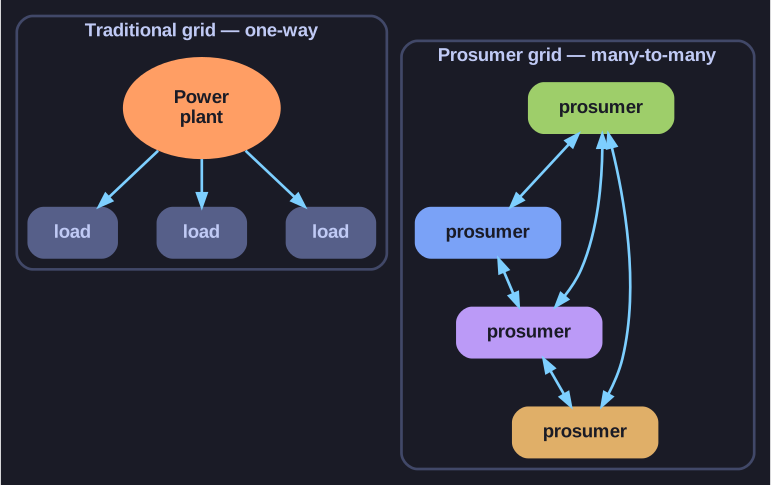
* A traditional grid pushes power one way from a few plants to many loads; renewables turn it into a bidirectional, many-to-many prosumer mesh. *
A traditional grid is hierarchical: a few large fossil-fuel plants generate power and push it one way to end users. Renewables (solar, wind) and DERs — small decentralized generators like rooftop panels and home batteries — break that model two ways:
- Intermittency. Their output depends on sun, wind, and weather, so generation is uncertain minute to minute. Demand was already variable; now supply is too, and the two can drift out of balance.
- Bidirectional flow. A consumer who installs generation becomes a prosumer (produces and consumes), feeding power back in. Flow is no longer top-down but many-to-many.
The grid must match supply to demand continuously; any imbalance shows up as voltage and frequency fluctuations. That is why accurate forecasting of production and consumption at each endpoint becomes the prerequisite for stability.
Go deeper:
 Smart grid (Wikipedia) — How two-way communication and intelligent devices let a grid absorb renewables.
- Distributed generation (Wikipedia) — The small, distributed energy resources (DERs) that replace a few large plants.