Why do social-media algorithms tend to amplify emotional and outrage-driven content?
Because emotional content — especially anger, outrage and indignation — drives engagement, and algorithms reward whatever drives engagement.
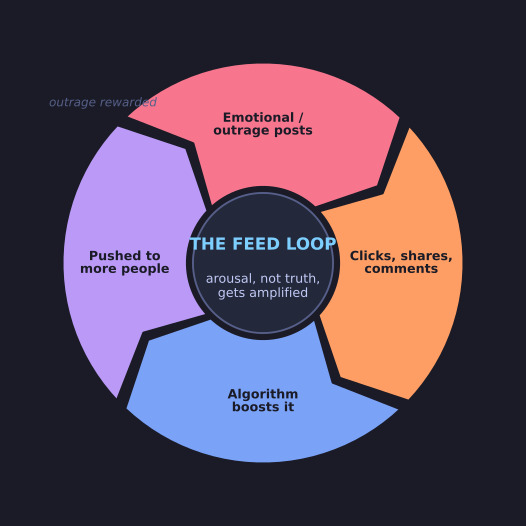
* Emotional posts win engagement; the algorithm reads engagement as importance and amplifies them — a self-reinforcing loop that rewards arousal over truth. *
The mechanism is simple and self-reinforcing: people click, comment and share more when a topic stirs strong feeling; the algorithm reads that high engagement as "this is important" and pushes the content to more people; that boosts engagement further. The result is an over-representation of emotional-moral topics in what we collectively see.
A related distortion is the attention bubble: things with little genuine news value get inflated simply because we keep talking about them — the talking itself changes how the topic is perceived and weighted. Trivialities get "washed up" to the surface while substantive issues get buried. So the feed isn't a neutral mirror of what matters; it's a machine optimised for arousal.
Go deeper:
 Wikipedia — Algorithmic radicalization — how engagement-optimising recommendation systems amplify incendiary content (and the contested evidence).
- Wikipedia — Attention economy — why finite human attention is the scarce resource platforms compete to capture.