Why do people who consider themselves decent end up participating in unethical practice?
Because a set of well-documented mechanisms — narrowed view, group pressure, diffusion of responsibility, distance from the victim, habituation and the reward system — each lower the moral cost of one more step.
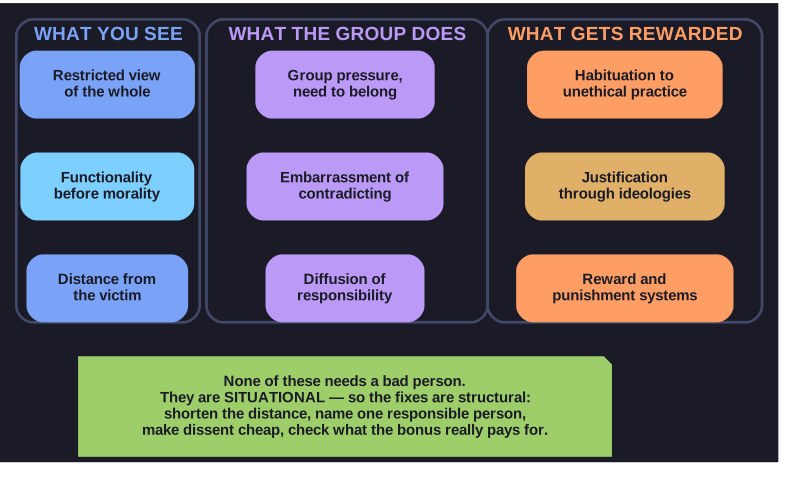
* All situational, none requiring a bad person — which is why the countermeasures are structural *
The standard list of reasons for ethical failure, each of which is a normal feature of organisational life rather than a character defect:
- Restricted view of the whole — you see your task, not what it is part of.
- Functionality before morality — "does it work?" crowds out "should it?"
- Group pressure and the need to belong — the cost of being the one who objects is immediate and social; the cost of the wrong is diffuse and later.
- The embarrassment of contradicting — objecting means implying your colleagues are doing something wrong, which is socially expensive in a way that silence never is.
- Diffusion of responsibility — where everyone is a little responsible, nobody is answerable.
- Distance from the victim — the people harmed are abstractions in a spreadsheet, not faces.
- Habituation to unethical practice — the first exception is agonising, the tenth is procedure.
- Justification through ideologies — a story ("the market demands it", "we're doing it for the customer") that converts the wrong into a necessity.
- Reward and punishment systems — the structure pays for the outcome and is silent about how it was reached.
The unifying insight is that these are situational, not dispositional. None of them requires a bad person; they explain how ordinary people end up doing things they would condemn if described to them from outside. That is why the countermeasures in the previous cards are structural — visibility, clear escalation routes, named responsibility, protected dissent — rather than appeals to be better.
Tip: Read the list as a design checklist. Each item names a condition you can remove: shorten the distance to the victim, name a single responsible person, make dissent cheap, and check what the bonus actually pays for.
Go deeper:
 Ethics Unwrapped: Ethical Fading — the mechanism behind »functionality before morality«: the ethical dimension quietly drops out of the framing.
- Ethics Unwrapped: Conformity Bias — why the cost of being the one who objects is immediate and social, and the cost of the wrong is not.
 Wikipedia: Diffusion of responsibility — the research behind »where everyone is a little responsible, nobody is answerable«.