What makes a situation a genuine dilemma?
Two equally ranked but incompatible values collide, so every available decision violates one of them — there is no option that leaves you unscathed.
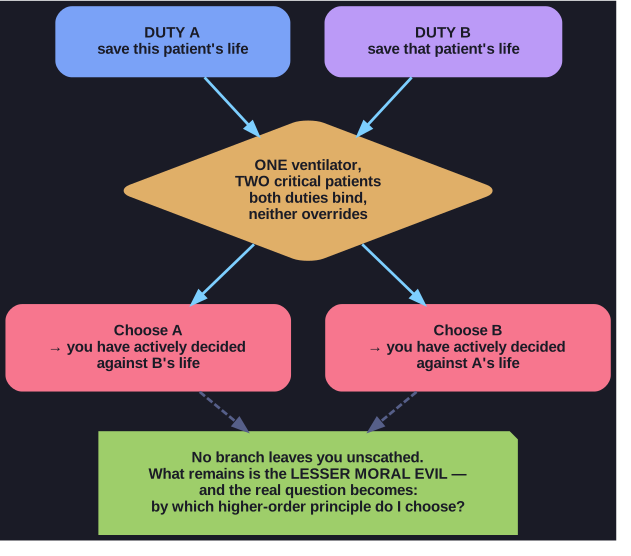
* No branch leaves you unscathed — which turns the question into »by which higher principle do I choose?« *
The definition has three components, and all three are needed:
- Two values of equal rank. If one clearly outranks the other, you have a hard decision, not a dilemma.
- Incompatible. Both cannot be honoured in this situation — not because of bad planning, but structurally.
- Every outcome unsatisfactory. Both possible decisions lead to an undesirable result. What is left is to choose the lesser moral evil.
The consequence is the part people resist: however you decide, you will have to violate a moral principle you yourself consider important. You do not escape by choosing well. You become, in some measure, "guilty" towards one value or one person — and a decision procedure that promises otherwise is misdescribing the situation.
Which is why the real questions in a dilemma are not "what is the right answer?" but: how can one decide without violating one's principles (answer: one cannot), and therefore by which higher-order principles can and should the decision be made? That is what the moral theories are for — not to dissolve the dilemma, but to make the choice between the two evils arguable rather than arbitrary.
Go deeper:
 Stanford Encyclopedia: Moral Dilemmas — the precise conditions for a genuine dilemma, and the serious argument that there are none.
- Wikipedia: Ethical dilemma — the overview with the standard worked examples.