Quiz Entry - updated: 2026.07.30
What is the State Channel pattern, and why are micro-payments its motivating case?
Two parties lock a deposit in a smart contract, then exchange many signed state updates (typically micro-payments) entirely off-chain, settling only the final net result on-chain — because putting every tiny payment on-chain would cost more in fees and latency than the payment is worth.
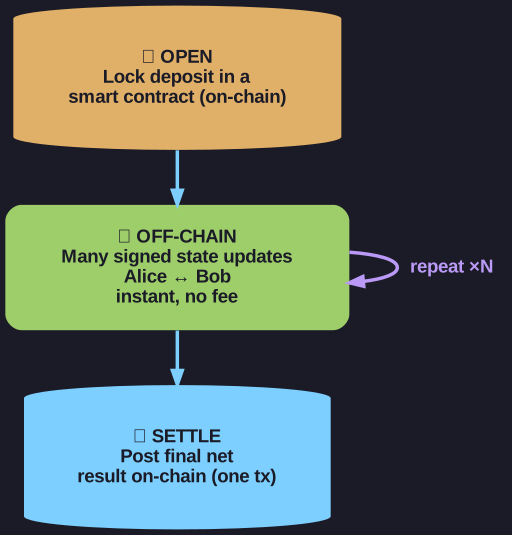
* Lock once, update off-chain as often as needed, settle the net once — only two on-chain transactions. *
- Problem. On-chain transactions are slow (minutes to hours to commit) and carry fees roughly independent of the amount — during one demand peak Bitcoin's average fee rose to about US$55. Paying a few cents for WiFi per 10 kB is impossible if each payment must be committed on-chain.
- Solution. Open a payment channel between two participants with a deposit locked in a smart contract for the channel's lifetime. The channel keeps intermediate states off-chain and records only the finalised net settlement on-chain, at a frequency the use case dictates (e.g. a utility bills monthly). Chained together, channels form a network allowing multi-hop payments where only the final settlement per channel hits the chain. Bitcoin's Lightning Network implements this with Hashed Timelock Contracts (HTLCs) — payment channels using hashlocks and timelocks that force the receiver to acknowledge a payment before a deadline via cryptographic proof. The idea generalises beyond money to any off-chain state updates.
- Trade-off. Benefits: speed, throughput, privacy (intermediate transactions never hit the public ledger), and cost (only the settlement pays a fee). Drawbacks: trustworthiness (off-chain intermediate states aren't in an immutable store and can be lost when a channel closes), reduced liquidity (funds are locked for the channel's lifetime), and the need for a new wallet or extension.
Go deeper:
 Lightning Network (Wikipedia) — Bitcoin's production state-channel network: bidirectional payment channels, HTLC-routed multi-hop payments, and on-chain settlement.