What is the oracle problem, and how do decentralized oracle networks solve it?
Blockchains are deterministic and cannot fetch outside data or run off-chain computation by themselves (the oracle problem); a decentralized oracle network is a group of independent providers that delivers external data and computation on-chain without reintroducing a single trusted party.
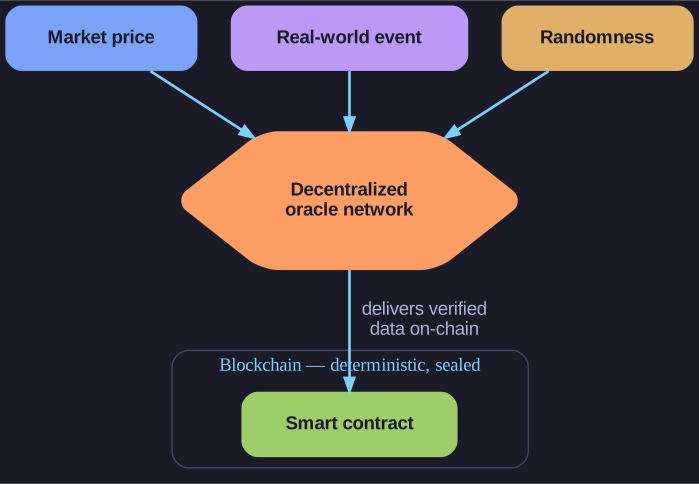
* A sealed, deterministic chain can't reach outside data on its own; a decentralized oracle network bridges real-world inputs in without a single trusted source. *
A blockchain is a sealed, deterministic world — every node must reach the same result, so a contract cannot simply reach out and read a stock price, a temperature, or a random number, because different nodes might see different answers. Yet most useful agreements need real-world data. An oracle is any mechanism that feeds external data to the chain or performs external computation for it. But using a single oracle would recreate exactly the centralized point of failure the blockchain was built to avoid — if that one source lies or goes down, the contract is compromised. The fix is a decentralized oracle network: many independent oracles that must agree, so the off-chain data and computation are as decentralized and trust-minimized as the on-chain logic. This is the missing half of a truly decentralized application.
Go deeper:
 The blockchain oracle problem — Chainlink — why chains can't reach off-chain, and how decentralized oracle networks fix it.
- Blockchain oracle — Wikipedia — the bridge between smart contracts and external data.