Quiz Entry - updated: 2026.07.30
What is the Off-Chain Data Storage pattern, and what exactly does anchoring a hash on-chain protect?
Store bulky data off-chain but write only its hash (a fixed-size fingerprint) on-chain — the chain then guarantees the hash's integrity, letting anyone detect if the off-chain data was tampered with, though it cannot recover or prevent the loss of that data.
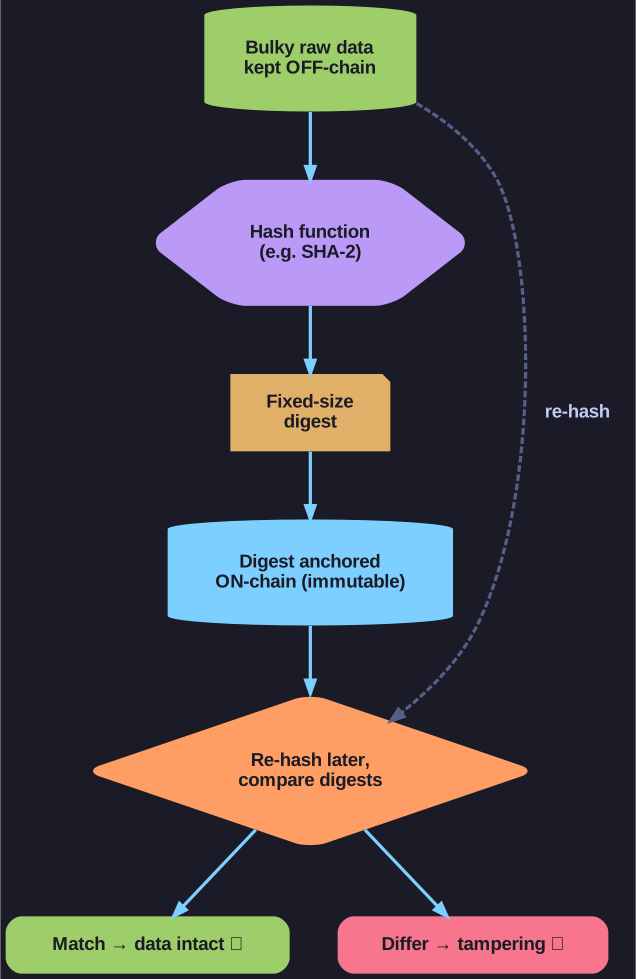
* Anchor only the digest on-chain — re-hash and compare to detect any off-chain tampering. *
- Problem. Full replication caps on-chain storage, and block-size limits make large data infeasible to embed (Bitcoin's
OP_RETURNallowed up to 80 bytes, later cut to 40; Ethereum's gas limit caps transaction data). You still want the chain's integrity guarantee for large datasets. - Solution. Run the raw data through a hash function (e.g. from the SHA-2 family) — a one-way function that maps arbitrary-size input to a fixed-size digest, easy to compute but infeasible to invert, where flipping a single input bit changes the whole output. Store only that digest on-chain; keep the raw data off-chain. The on-chain hash guarantees the raw data hasn't changed.
- Benefits. Integrity (compare off-chain data against the on-chain hash to detect any change) and cost (fixed, low storage cost regardless of data size).
- Drawbacks. The off-chain store may be less secure (you can detect a change but can neither recover the original nor prevent the alteration); data loss (off-chain data can be deleted, leaving only its orphaned hash); data sharing needs extra off-chain machinery.
Go deeper:
 Cryptographic hash function (Wikipedia) — why a one-way, collision-resistant digest lets a tiny on-chain fingerprint stand in for arbitrarily large off-chain data.