What is the gambler's fallacy?
Believing that a run of one outcome makes the opposite outcome "due" — for independent events, the past doesn't change the odds.
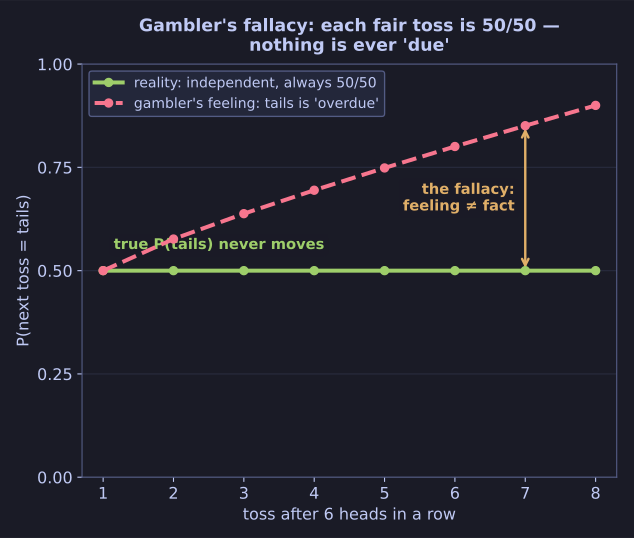
* For independent events the true probability stays 50/50 no matter the streak; the rising "it's overdue" feeling is the fallacy. *
The pattern: X has happened a lot (departing from the long-run average), therefore X is now less likely / its opposite is overdue. For independent events it fails because each trial has no memory — a fair coin that landed heads six times in a row still has exactly a 50% chance of heads on the seventh toss.
"Red has come up on the roulette wheel five times straight, so black is bound to come next."
The wheel doesn't track its own history; the odds reset every spin. The "law of averages" works over the long run, not by self-correcting in the short run. (Reasoning can be sound where outcomes are dependent — e.g. drawing cards without replacement — but not for independent trials.)
Tip: Independent events have no memory. "Due for a win" after a losing streak is the classic tell.
Go deeper:
 yourlogicalfallacyis.com — The gambler's fallacy — "it's overdue" reasoning, in one page.
 Wikipedia — Gambler's fallacy — independence, the Monte Carlo 1913 episode, and the inverse fallacy.