Question
What is a "logical fallacy," and how does it differ from simply being wrong about a fact?
Answer
A pattern of reasoning that feels persuasive but is logically broken — the premises don't actually support the conclusion, even when they happen to be true.
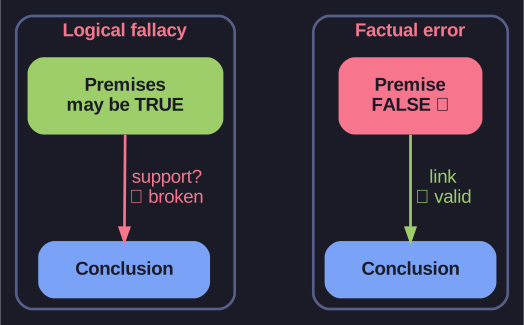
* A fallacy breaks the premise-to-conclusion link (the premises can even be true); a factual error is a false premise on a valid link. *
An argument is one or more premises offered to support a conclusion. A fallacy is an error in the reasoning that links them — the premises are presented as supporting the conclusion, but they don't provide the needed support. That is different from a factual error, which is just being wrong about the world ("Columbus is the capital of the USA"). A fallacy can have entirely true premises and still be a fallacy, because the connection is what fails.
- Factual error: the facts are wrong.
- Fallacy: the facts may be fine, but they don't justify the conclusion drawn from them.
Crucially, a fallacious argument can still reach a true conclusion — by luck, not by logic. So spotting a fallacy tells you the argument gives you no good reason to accept the conclusion; it does not tell you the conclusion is false.
Tip: Two-part test — "Are the premises actually relevant to the conclusion, and do they actually establish it?" If either answer is no, you may be looking at a fallacy.
Go deeper:
 Wikipedia — Fallacy — what fallacies are and how they're classified into formal and informal.
 yourlogicalfallacyis.com — the interactive fallacy poster — the companion site to the poster these cards are drawn from; click any fallacy for a plain-English page.
Note saved — thanks!
Question
What is the difference between a formal and an informal fallacy?
Answer
A formal fallacy is broken by its logical structure alone; an informal fallacy is broken by its content — irrelevant or unwarranted premises dressed up as support.
The distinction is about where the error lives:
| Formal fallacy | Informal fallacy | |
|---|---|---|
| Where the flaw is | The argument's form/structure | The argument's content/context |
| Detectable by | Logic alone, ignoring meaning | Reading what's actually said |
| Example | "If P then Q; Q; therefore P" (affirming the consequent) | Ad hominem, straw man, slippery slope |
A formal fallacy is invalid no matter what you plug in — e.g. "If Portland is the capital of Maine, it's in Maine; Portland is in Maine; therefore Portland is the capital" — the shape is wrong (Portland is in Maine but Augusta is the capital). An informal fallacy looks fine structurally; the defect is that a premise is irrelevant, biased, or smuggles in the conclusion. Most of the famous named fallacies (ad hominem, red herring, appeal to emotion) are informal.
Go deeper:
- Wikipedia — Formal fallacy — errors of logical form, invalid whatever you plug in.
- Wikipedia — Informal fallacy — errors of content and context, where most named fallacies live.
Note saved — thanks!