What is the framing effect?
Your decision changes depending on how an option is worded or presented, even when the underlying facts are identical.
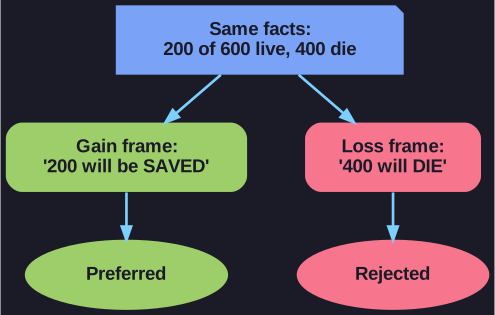
* Tversky & Kahneman's 'Asian disease' problem: identical odds worded as a gain versus a loss flip which option people pick. *
The mechanism is that we respond to the emotional and reference-point colouring of a description rather than to the raw facts — and gains versus losses feel very different even when they describe the same outcome. "Saving" something triggers different instincts than "losing" the same thing.
Example: "This surgery has a 90% survival rate" and "this surgery has a 10% mortality rate" describe exactly the same risk, yet patients are far more willing to choose the surgery framed as 90% survival. Likewise "95% fat-free" sells better than "contains 5% fat."
Tip: When a choice hinges on the phrasing, re-state the option the opposite way ("what's the loss version of this gain?") and see if your preference survives.
Go deeper:
 Wikipedia — Framing effect — gain/loss framing and prospect theory.