Question
What is a cognitive bias, and how does it differ from a logical fallacy?
Answer
A cognitive bias is a systematic, predictable error in how the mind perceives, remembers or judges; a logical fallacy is a flaw in the structure of an argument.
The two are easy to confuse because both lead to wrong conclusions, but they live in different places:
| Cognitive bias | Logical fallacy | |
|---|---|---|
| Where it sits | In your thinking/judgement | In an argument's structure |
| Nature | A built-in mental shortcut that misfires | A reasoning step that doesn't follow |
| Example | Believing a claim more because you've heard it often | "Everyone believes it, so it's true" (ad populum) |
| Fix | Notice it and consciously correct for it | Point out the broken inference |
A bias is something your brain does to you automatically — a side-effect of shortcuts (heuristics) that are usually efficient but predictably wrong in certain situations. A fallacy is something in the words of an argument you can lay out and inspect. The same mistaken belief can involve both: a bias makes the conclusion feel right, and a fallacy is the broken reasoning you'd use to defend it.
Tip: Biases are about the thinker; fallacies are about the argument. "Know thyself" targets biases — you can't audit an argument you're too biased to question.
Go deeper:
 Wikipedia — Cognitive bias — the umbrella concept: what biases are and where they come from.
- Wikipedia — List of cognitive biases — a catalogue of ~200 documented biases, grouped by cause.
 yourbias.is — the interactive bias poster — the companion site to the 24-bias poster these cards are drawn from.

Note saved — thanks!
Question
What is confirmation bias, why do our minds do it, and what does it look like in practice?
Answer
The tendency to seek, notice and remember evidence that supports what you already believe, while overlooking or discounting evidence that doesn't.
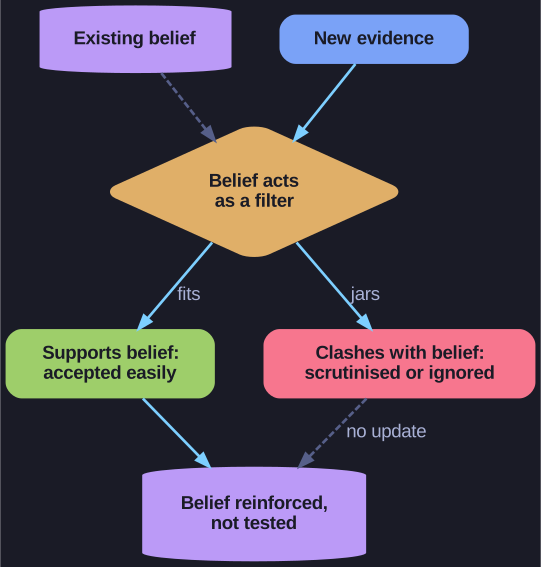
* A prior belief acts as a filter: confirming evidence is accepted easily, contradicting evidence scrutinised or ignored. *
The mechanism is that holding a belief is comfortable and revising one is costly. Once a belief is in place, the brain treats it as the default and grades incoming information against it: confirming evidence is accepted easily, contradicting evidence is scrutinised harshly or filtered out before it registers. We're effectively building a case for a verdict we've already reached, not testing a hypothesis.
Example: You decide a new colleague is unfriendly. Afterwards you vividly notice every curt reply, and the times they were warm or helpful slide past unremembered — so the evidence "piles up" in favour of a conclusion you formed on day one.
Tip: The antidote is to deliberately go looking for what would prove you wrong. If you only ever find agreement, you may simply not be looking for disagreement.
Go deeper:
- Wikipedia — Confirmation bias — the mechanisms, classic experiments and real-world fallout.

Note saved — thanks!