What is the Endpoint Mini Server (EMS), and what hardware and software does it bundle together?
A small server at each grid endpoint (e.g. a house) that encapsulates its metering hardware, a forecasting AI, and a transaction module — turning a passive meter into an autonomous trading agent.
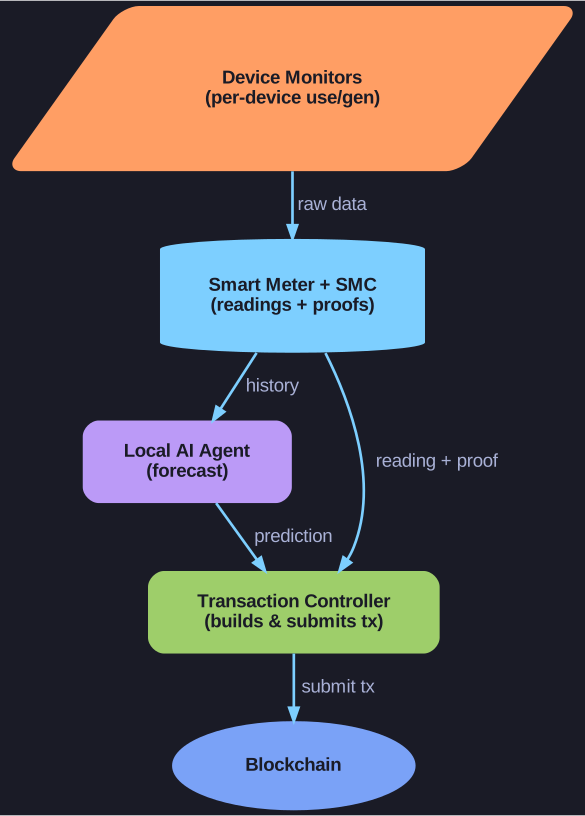
* Inside an EMS: device data flows through the smart meter (readings + proofs) to a forecasting AI and a Transaction Controller that submits trades on-chain. *
The Endpoint Mini Server (EMS) is deployed and maintained at each endpoint (residential houses, or large assets like EVs). It wraps the endpoint's hardware and logic behind one component interface, so existing kit can be upgraded compatibly rather than replaced. Its parts:
- Device Monitors (DMs) — generate real-time consumption/production data for individual household devices (a washing machine, a panel).
- Smart Meter (SM) + Smart Meter Controller (SMC) — the meter aggregates all device data; the SMC layer above it produces verifiable proofs of that data.
- Local AI Agent — uses historical data to forecast the endpoint's future production and consumption.
- Transaction Controller (TC) — aggregates meter and AI data and, on a fixed interval, generates and submits transactions to the blockchain automatically.
The point is local autonomy: each endpoint can forecast and trade on its own, adjusting its devices to stay near predicted values.
Go deeper:
 A Blockchain-Based Architecture for Energy Trading (Sun & Weingärtner, HSLU, Electronics 2025) — The primary paper: the EMS, trading platform, and PoD in full.
- Smart meter (Wikipedia) — The metering component the EMS wraps and augments with a controller.