What is "Proof-of-Prediction" (PoD), and how does it choose who proposes the next block?
A Proof-of-Stake-style consensus where the block proposer is the participant whose energy forecast best matched their actual usage — rewarding accurate, well-behaved endpoints with tokens.
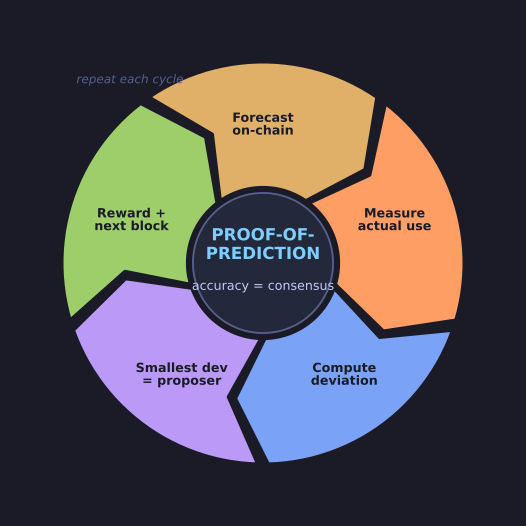
* Proof-of-Prediction as a repeating cycle: the endpoint whose forecast best matches reality wins the next block and a reward — accuracy is what secures the chain. *
Ordinary consensus picks a block proposer by computation (Proof-of-Work) or wealth (Proof-of-Stake). Proof-of-Prediction (PoD) repurposes that selection to serve grid stability:
- Each cycle, every endpoint records its AI forecast of its own production/consumption on-chain.
- At the cycle's end, actual usage is measured and the deviation between predicted and actual is computed per participant.
- The participant with the smallest deviation — the most accurate forecaster — is designated block proposer for the next cycle and earns token rewards.
The clever part is the incentive: to win, an endpoint must make its real consumption match its predicted consumption, so it actively steers its devices to stay within the forecast range. Consensus and demand-side management become the same act — predictable behaviour is literally what secures the chain.
Go deeper:
 Proof of stake (Wikipedia) — The consensus family PoD adapts, choosing a proposer by a criterion rather than by work.
- A Blockchain-Based Architecture for Energy Trading (Sun & Weingärtner, HSLU, Electronics 2025) — The primary paper defining Proof-of-Prediction and its incentive design.