What is "exactly-once processing", and why do financial systems prize it over "at-least-once"?
Exactly-once processing means each external event drives its effect one time and one time only — never lost, never duplicated — which for money-moving systems matters more than the alternative of possibly processing something twice.
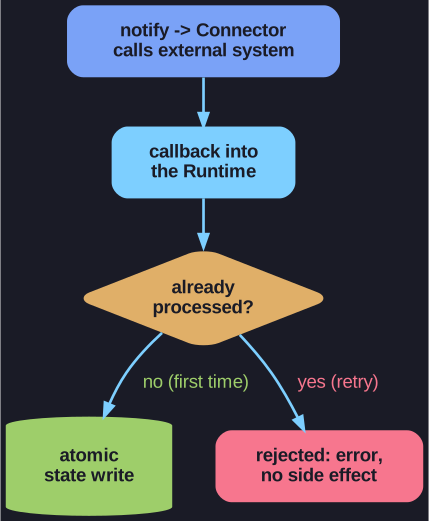
* The persisted state records whether an event was handled, so a retry of an already-processed event is safely rejected — idempotent. *
In event-driven systems there is a spectrum of delivery guarantees. "At-least-once" retries until it is sure the event landed, but risks doing the work twice; "at-most-once" never duplicates but can drop events. For financial applications, processing an event exactly once is more critical than the risk of losing the event entirely — a duplicated payment is a real loss, so correctness beats mere delivery. Noumena achieves exactly-once through transactional state management and controlled callback mechanisms: the persisted state of the process records whether an event has already been handled. If a service crashes mid-flight, the event can be safely retried; if the event was already processed, the Engine detects it from the stored state and reports an error instead of re-doing the work.
Go deeper:
 Idempotence (Wikipedia) — the property that makes a safe retry possible: applying the same operation again changes nothing beyond the first application.