What is "circularity" (Zirkularität) in a system, and what produces it?
Influence that runs in a loop instead of a straight line — produced by feedback, where an effect becomes a cause that feeds back on its own origin.
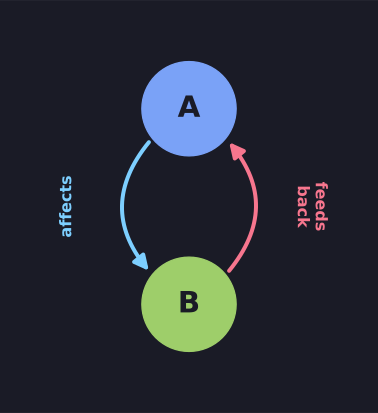
* Circularity: an effect loops back to change its own cause, so each variable is both cause and effect depending where you cut the loop. *
In linear thinking, A causes B and the story ends. In a system, B can loop back and change A, which again changes B — a feedback process (Rückkoppelung). This circular causality has consequences:
- "Cause" and "effect" stop being fixed roles; each is both, depending where you cut the loop.
- Behaviour can run away or self-stabilise without any outside push, just from the loop feeding itself.
- Blame becomes slippery: in a vicious-circle argument, asking "who started it?" misreads a loop as a line.
A good mental image is an "impossible staircase" that climbs forever and yet returns to where it began — the path is continuous and self-referential, with no real start or end, the way a feedback loop has no first cause.
Tip: Whenever an effect quietly reaches back and nudges its own cause, you've found a loop — that's circularity.
Go deeper:
 Wikipedia — Feedback — outputs routed back as inputs, the mechanism behind circular causality.
 Wikipedia — Causal loop diagram — how systems thinkers draw these loops and read their polarity.