Question
What is a "system" in systems thinking, and what three things make something a system?
Answer
A whole made of elements, the interconnections between them, and an overarching purpose or logic — the interactions, not the parts, are what define it.
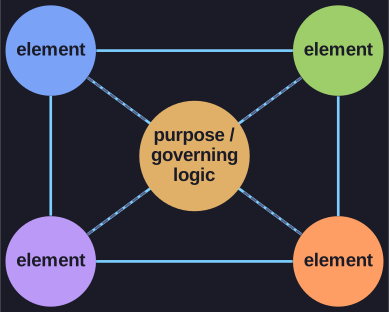
* A system is elements joined by interconnections and governed by one shared purpose or logic — rearrange the links and you get a different system. *
Systems thinking (German Systemdenken) treats a thing not as a pile of parts but as an organised whole. Three ingredients have to be present:
- Elements — the components (people, organs, departments, variables).
- Interconnections — the relationships and flows that link the elements and let them influence one another.
- A purpose or governing logic — the system has its own "rules of the game" (the sociologist Niklas Luhmann called these Kommunikationslogiken, communication logics) that aren't reducible to any single part.
The decisive shift is the interconnections: a body is more than a heap of organs, a team more than a list of names. Rearrange the same elements with different relationships and you get a different system. That's why the field deliberately avoids one fixed, narrow definition — it's a transdisciplinary lens, borrowing from biology, medicine, physics, sociology and psychology, rather than a single theory.
Tip: A heap of bricks is not a house. Same elements, no interconnections, no purpose — no system.
Go deeper:
 Wikipedia — Systems thinking — making sense of the world in terms of wholes and relationships rather than isolated parts.
Note saved — thanks!
Question
Why is systems thinking called a "metaconcept" with roots in many disciplines rather than one theory?
Answer
Because it isn't a single doctrine but a cross-disciplinary way of seeing, assembled from biology, physics, sociology, psychology and more — and still evolving.
Systems thinking pulls ideas from wherever wholes-with-interactions show up:
- Biology — Maturana and Varela's autopoiesis: living systems continuously produce and maintain themselves (self-organisation).
- Physics / philosophy — radical constructivism (Heinz von Foerster, Ernst von Glasersfeld): what we "know" is constructed by the observer, not read off a ready-made world.
- Communication / therapy — the Palo Alto school (Bateson, Watzlawick, Satir): behaviour only makes sense in its relational context.
- Sociology — Luhmann's systems theory: society as self-referential communication systems.
Because no one field owns it, there is no single correct system definition or model. That openness is the point: it's a flexible "Denk-Alternative" (alternative way of thinking) to the usual linear, purely rational logic — a lens you apply, not a formula you memorise.
Go deeper:
- Wikipedia — Autopoiesis — Maturana & Varela's biology of self-producing living systems, one of the roots named above.
- Wikipedia — Constructivism (philosophy of science) — the radical constructivism of von Foerster and von Glasersfeld, another of its roots.
Note saved — thanks!