What is an address, and how does it relate to your public key?
An address is a short public identifier for your account, derived from your public key — for example, on Ethereum by hashing the public key and taking the last 20 bytes.
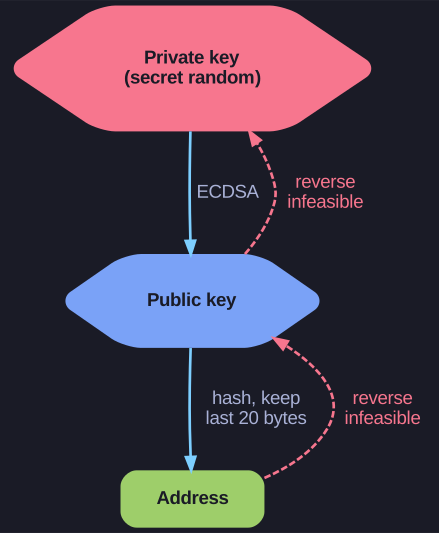
* Private key → public key → address, each arrow one-way: the forward path is easy, but you cannot work backwards. *
Your address is what you share so others can send you funds, and what appears in the public ledger as the "from" and "to" of transactions. It is derived deterministically from your public key (Ethereum hashes the public key and keeps the last 20 bytes), so it inherits the safety of being public — revealing your address never endangers your funds. The chain of derivation is worth memorizing: private key → public key → address, each step one-way. The private key must stay secret; the public key and address are meant to be shared. Exact derivation details differ between blockchains, but the principle — an address is a public fingerprint of a public key — is universal.
Go deeper:
 Ethereum accounts — ethereum.org — the exact private-key → public-key → address derivation on Ethereum.
- Public-key cryptography — Wikipedia — why a public key (and the address from it) is safe to share.