What is a reverse proxy, which tasks can it take on, and why is it not only a security tool?
A reverse proxy sits in front of one or more servers and accepts client requests in their place, terminating the connections. It can hold the SSL certificates and encrypt/decrypt, hide the servers' addresses, cache static content, balance load and absorb overload, and with extended functions inspect requests for malicious content and manipulated URLs, which makes it the base of an application-level firewall. The same technique is also a hacking tool.
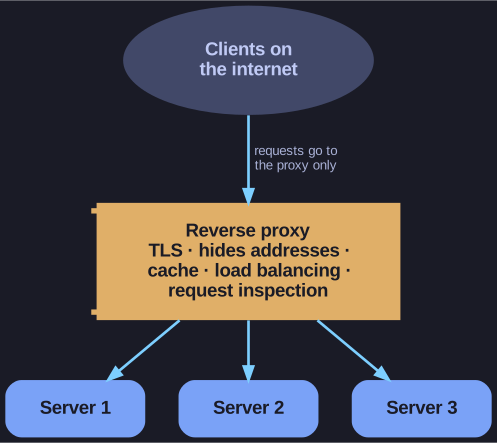
* Clients only ever talk to the proxy; the servers behind it stay hidden. *
A forward proxy acts for clients going out; a reverse proxy acts for servers being reached from outside. It comes as hardware or as software installed on a computer.
A clear example is mitmproxy ("man-in-the-middle proxy"), which can be configured as a proxy or a reverse proxy. Sitting in the middle of a connection and reading it in clear text is exactly what an attacker wants to do, so the same tool that protects a server can be used to intercept someone else's traffic.
Go deeper:
 Reverse proxy — Wikipedia — its main uses: TLS, hiding servers, caching, load balancing.
- mitmproxy — Modes of operation — the same tool as forward proxy, reverse proxy or transparent interceptor.