What does it mean to run a router interface "dual stack", and why do both address families sit on the same interface?
Dual stack means the interface carries a complete IPv4 configuration and a complete IPv6 configuration at once, running the two protocols side by side over one physical link.
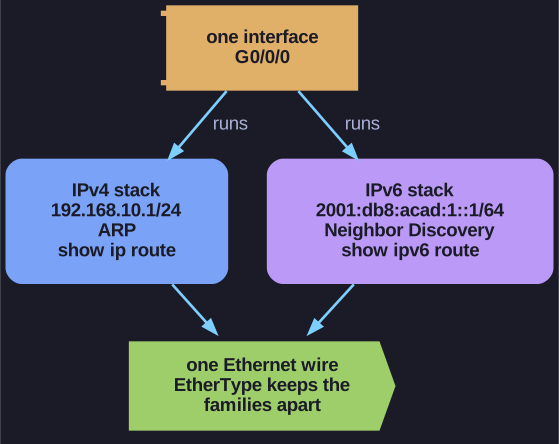
* Two independent stacks, one wire. *
R1(config)# interface gigabitethernet 0/0/0
R1(config-if)# ip address 192.168.10.1 255.255.255.0
R1(config-if)# ipv6 address 2001:db8:acad:1::1/64
R1(config-if)# description Link to LAN 1
R1(config-if)# no shutdown
The two stacks are genuinely independent: separate addresses, separate routing tables (show ip route versus show ipv6 route), and separate neighbour resolution — ARP (Address Resolution Protocol) for IPv4, Neighbor Discovery for IPv6. Nothing is translated between them. An IPv4 packet and an IPv6 packet simply take turns on the same Ethernet wire, kept apart by the EtherType field in the frame header.
Why this is the standard way to migrate: IPv4 and IPv6 cannot talk to each other on the wire, so a network can't flip from one to the other overnight without cutting off everything that still speaks only the old one. Dual stack sidesteps the problem — every host and router speaks both, each conversation quietly uses whichever family both ends support, and IPv4 can be retired later without a flag day.
The cost is two of everything: two address plans to design, two routing tables to reason about, two sets of filters to maintain. That last one is the security trap — an IPv6 configuration nobody monitors is still fully reachable, so a network hardened only on its IPv4 side has a second, unwatched front door.
Go deeper:
 List of IPv6 transition mechanisms (Wikipedia) — where dual stack sits among the alternatives (tunnelling, translation) and what each costs.
- RFC 4213 — Basic Transition Mechanisms for IPv6 Hosts and Routers — the specification that defines the dual-stack node this card describes.