What does cyber security architecture do that buying individual security products does not?
It is the discipline of the whole construction: which building blocks are chosen, how they are wired together, and which processes run around them — for one defined stretch of a cyber system.
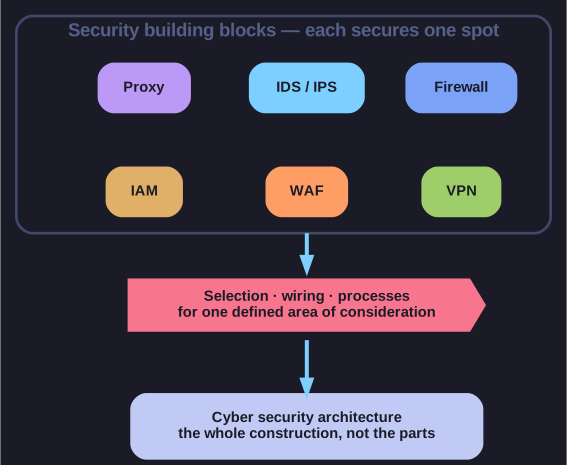
* Products are the materials; the architecture is the plan that selects, wires and operates them for one defined area. *
The security market sells parts, not buildings. Network security secures networks, an intrusion detection system acts as a burglar alarm, a virus scanner keeps malware off a host, a web application firewall filters HTTP traffic, an IAM system decides who may log in. Each product secures one spot or one aspect, and each is perfectly capable of being correct in isolation while the estate around it stays wide open.
Architecture is the level above that. It answers three questions that no single product answers:
- Selection — which blocks does this estate actually need? (An expensive product that guards a door nobody uses buys nothing.)
- Wiring (Verschaltung) — how do they connect, what does traffic have to pass, where are the boundaries and the control points?
- Processes — who patches, who reviews the rules, who grants access, what happens on an alert? A firewall whose rule set nobody prunes decays into a router.
And crucially it applies to a defined area of consideration (Betrachtungsraum) — a system, a site, a company, an estate — because "secure" is only meaningful once you have said what is being secured and where it ends.
The building analogy holds up well: bricks, pipes, steel and glass are the materials; a house is what happens when someone decides which ones, in what arrangement, for which purpose. Products are materials. Architecture is the plan.
Go deeper:
 Wikipedia — Enterprise information security architecture — the established frameworks (SABSA, TOGAF, Zachman) that formalise exactly this planning layer.