The infrastructure is described as a "three-in-one" system. What are the three control layers and what does each cover?
Endpoint self-control (local forecasting and device adjustment), distributed regulation (incentive-driven trading), and global coordination (a macro platform) — micro, market, and macro stability in one stack.
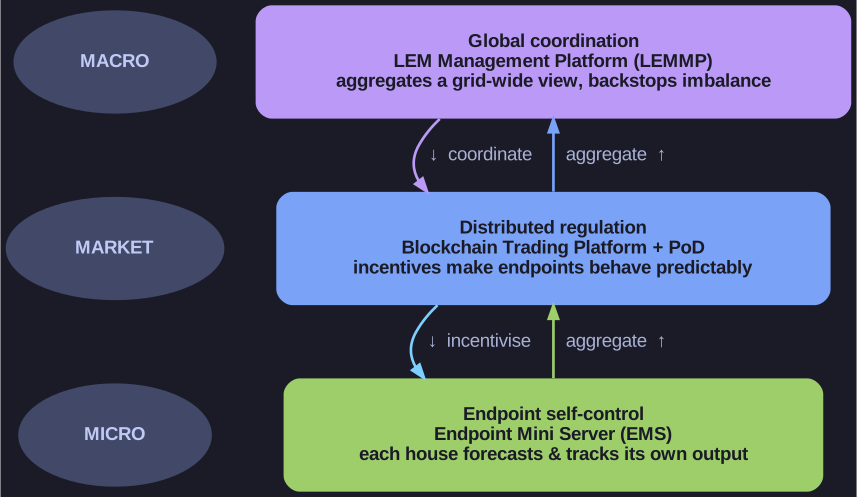
* Three layers attack instability at once: the EMS (micro), incentive-driven trading (market), and the LEMMP backstop (macro) — data aggregates up, coordination flows down. *
Stability is attacked at three scales simultaneously, one component per scale:
| Layer | Component | What it does |
|---|---|---|
| Endpoint self-control | Endpoint Mini Server (EMS) | Each endpoint forecasts and adjusts its own devices to track predicted output |
| Distributed regulation | Blockchain Trading Platform + PoD | Token incentives push endpoints to behave predictably; trading balances supply and demand market-wide |
| Global coordination | LEM Management Platform | Aggregates a grid-wide view and intervenes on macro imbalance |
The insight is that no single layer suffices: pure P2P trading (only the middle layer) leaves fluctuations uncoordinated, and pure central control loses local flexibility. Combining local autonomy, incentive-aligned trading, and a macro backstop is what makes the grid self-regulating and resilient.
Go deeper:
 A Blockchain-Based Architecture for Energy Trading (Sun & Weingärtner, HSLU, Electronics 2025) — The primary paper laying out the full three-layer architecture.
- Smart grid (Wikipedia) — The broader vision of a self-regulating, communication-rich electrical grid.