Structurally, what is "a coin" in Bitcoin?
A coin is a chain of digital signatures — there is no coin file; each owner passes it on by signing a hash of the previous transaction plus the next owner's public key.
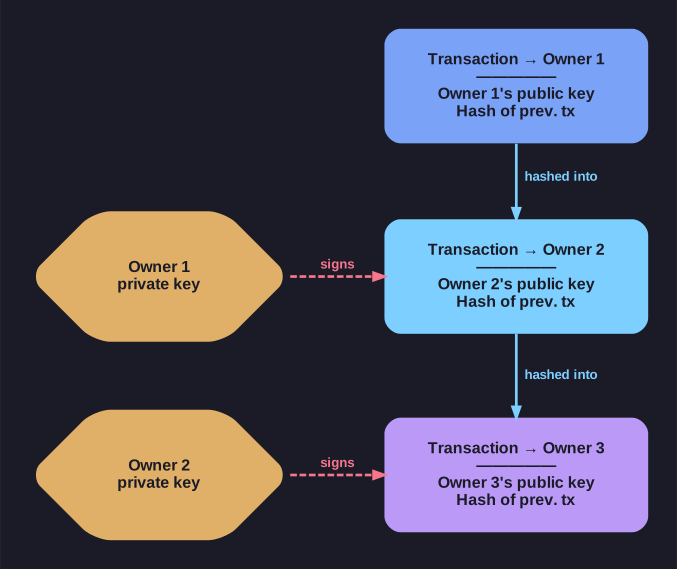
* Each transaction folds in a hash of the previous one plus the recipient's public key; the current owner's private key signs it, extending the ownership chain. *
To transfer a coin, the current owner signs hash(previous transaction + recipient's public key) with their private key and appends that signature to the coin. Anyone can then verify the signatures to trace the chain of ownership back through its history.
This gives strong proof of ownership — but on its own it can't stop the current owner from signing the same coin over to two different people. Preventing that (double-spending) is what the rest of the network is for.
Watch the word coin, though: there's no divisible balance you top up and draw from. The real spendable unit is a whole transaction output — an amount locked to a key — and you can't spend part of one. A payment consumes entire earlier outputs as inputs and mints brand-new outputs. So to send 0.3 while holding 0.1 (received from A) and 0.2 (from B), you feed both outputs in as inputs and create a single 0.3 output to the recipient; if the inputs overshoot the payment, the remainder comes back to you as a change output, and the small gap left between inputs and outputs is the miner's fee. An output nobody has spent yet is what today's Bitcoin calls a UTXO (unspent transaction output) — the real structural stand-in for "a coin".
Go deeper:
 Bitcoin whitepaper, section 2 "Transactions" — Nakamoto — the source of the "chain of digital signatures" definition and its Figure 1.
- Digital signature — Wikipedia — how signing a hash with a private key proves authenticity and lets anyone verify with the public key.
- Unspent transaction output (UTXO) — Wikipedia — the modern structural model behind the whitepaper's "coin": an unspent (value, locking-script) output, addressed by the transaction that made it and its output index.