Responsibility has four elements — which are they, and which question does each answer?
Subject (who is responsible?), object (for what?), the responsibility relation (how far does it reach?), and the instance (answerable to whom?).
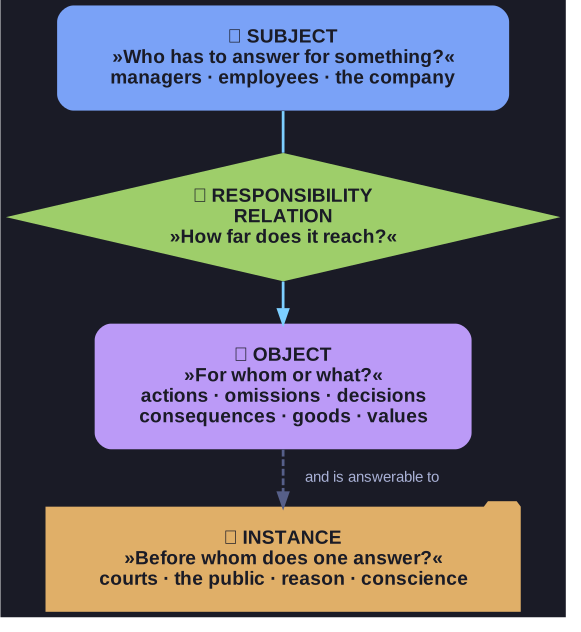
* Who answers, for what, how far it reaches, and before whom *
| Element | Question | Examples |
|---|---|---|
| Subject of responsibility | Who has to answer for something? | Managers, employees, the company itself (and consumers, investors, politicians …) |
| Object of responsibility | For whom or what does the subject answer? | Tasks, actions, omissions, decisions, consequences, addressees, states of affairs, goods, values |
| Responsibility relation | What relationship exists between subject and object? How far does a subject's responsibility reach? Which subject is responsible for a given object? | — |
| Instance of responsibility | Before whom does one answer? | Courts, the public, God, reason, conscience |
Two of these repay attention because they are where real disputes live.
The object list includes omissions and consequences, not just actions. That is the difference between "I didn't do anything" as an excuse and as an admission. It is also why "I only built the tool" is a weak defence: consequences are an object of responsibility.
The relation is where responsibility is actually contested. Everyone agrees the developer is responsible for the code; the fight is over how far downstream that reach extends, and whether responsibility that is shared by twenty people is therefore borne by nobody — the diffusion of responsibility that shows up as a standard reason for ethical failure.
The instance list is worth noticing too: it runs from the external and enforceable (courts, the public) to the internal and unenforceable (reason, conscience). A person who answers only to the first will do whatever is not provably illegal.
Go deeper:
 Stanford Encyclopedia: Moral Responsibility — the conditions under which anyone is responsible at all — control and knowledge.
- Wikipedia: Moral responsibility — the overview, including responsibility for omissions and for collective action.