On the classical account, what makes a character trait a virtue?
Being the mean between two extremes — the "golden mean": each virtue sits between a deficiency and an excess of the same quality.
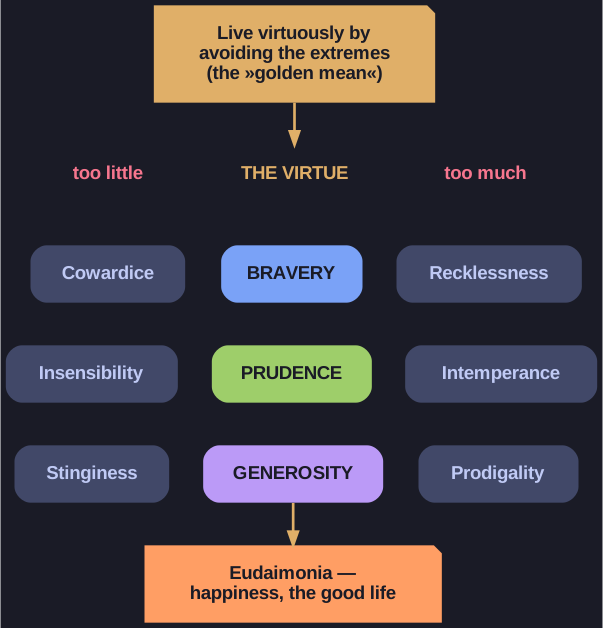
* Each virtue has two failure modes, not one — and the mean is not the average *
The Aristotelian structure, and the reason virtue ethics is not simply "have nice traits": virtues are not maximised, they are balanced. To live virtuously is to avoid the extremes.
| Deficiency (too little) | Virtue (the mean) | Excess (too much) |
|---|---|---|
| Cowardice (Feigheit) | Bravery (Tapferkeit) | Recklessness (Tollkühnheit) |
| Insensibility (Gefühllosigkeit) | Prudence / temperance (Besonnenheit) | Intemperance (Zügellosigkeit) |
| Stinginess (Geiz) | Generosity (Grossmut) | Prodigality (Verschwendungssucht) |
And the reason it matters: the chain runs avoid the extremes → develop the virtue → eudaimonia, happiness, the good life. Virtue is not a sacrifice you make for others' benefit; on this account it is constitutive of living well yourself.
Two things follow that are easy to miss. First, the mean is not the average and not mediocrity — bravery is not "moderately courageous", it is the right amount of fear for the actual danger, which in a genuine emergency may be a great deal of courage. Second, the mean is relative to the situation and the person, which is exactly why virtue ethics yields no rule book: knowing where the mean lies is the skill being cultivated.
Tip: Any virtue you can name has two failure modes, not one. If you can only think of the opposite vice, you have found half the picture — ask what "too much of this" looks like.
Go deeper:
 Stanford Encyclopedia: Aristotle's Ethics — section 5 is the doctrine of the mean itself, including why it is not a mechanical calculation.
 Crash Course Philosophy: Aristotle & Virtue Theory — ten minutes on the mean, habituation and eudaimonia.
- Wikipedia: Golden mean (philosophy) — the doctrine across traditions, with the classic table of virtue triples.