How does Bitcoin let you pay an arbitrary amount without a separate transaction for every unit of value?
Transactions carry multiple inputs and outputs — typically several inputs combined, and at most two outputs: the payment itself and the change returned to the sender.
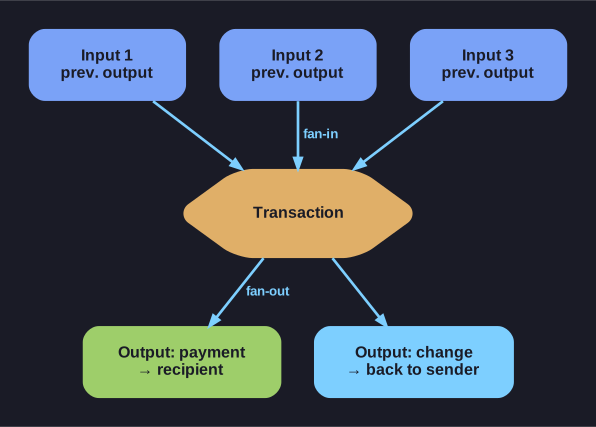
* Several earlier outputs fan in as inputs; the transaction fans out to two outputs — the payment and the change back to the sender. *
Handling each coin unit individually would be unwieldy, so value is split and combined through inputs/outputs. A normal transaction has either one input from a larger previous transaction or several smaller inputs merged, and usually two outputs (payment + change).
Two rules make it click: an input always spends a whole earlier output — never part of one — and whatever is left over, sum(inputs) − sum(outputs), is the miner's fee. Because your outputs almost never add up to the exact amount, the wallet sends the remainder back to you as a change output — which is why nearly every payment has two outputs.
Fan-out — a transaction depending on many earlier transactions, which depend on many more — isn't a problem: you never need to extract a complete standalone copy of a coin's entire history to spend it.
Go deeper:
 Bitcoin — Wikipedia — the transaction model, including how inputs and outputs combine value and return change.