How do you read the value of a four-band through-hole resistor, for example yellow, violet, red, gold?
Bands 1 and 2 are digits, band 3 is the power-of-ten multiplier and band 4 is the tolerance, so yellow (4), violet (7), red (×100), gold (±5%) is 47 × 100 = 4700 Ω = 4.7 kΩ, ±5%.
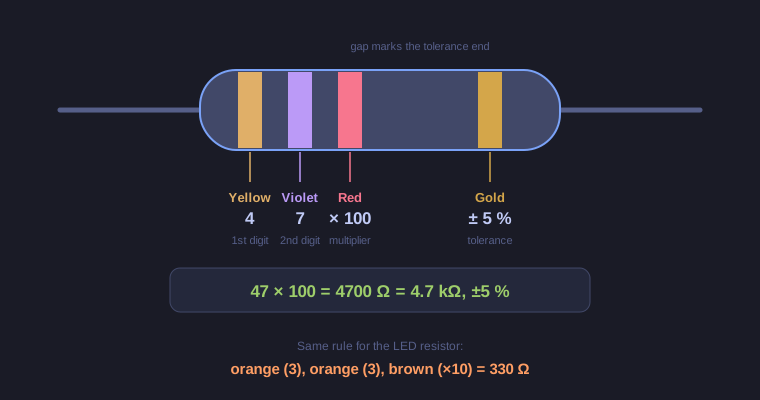
* Two digits, one multiplier, one tolerance: 4, 7, ×100, ±5%. *
A resistor limits the flow of electrons through a circuit, and its resistance is measured in ohms (Ω). Through-hole resistors are too small to print a number on, so they use coloured bands:
| Colour | Digit | Multiplier |
|---|---|---|
| Black | 0 | ×1 |
| Brown | 1 | ×10 |
| Red | 2 | ×100 |
| Orange | 3 | ×1,000 |
| Yellow | 4 | ×10,000 |
| Green | 5 | ×100,000 |
| Blue | 6 | ×1,000,000 |
| Violet | 7 | ×10,000,000 |
| Grey | 8 | ×100,000,000 |
| White | 9 | ×1,000,000,000 |
Tolerance band: gold ±5%, silver ±10%. The tolerance band is set apart, usually with a larger gap, which tells you which end to start reading from. The digit and multiplier columns follow the same order, so the multiplier is simply "add that many zeros": red = 2 zeros, so 47 becomes 4700.
The 330 Ω resistor used for an LED is orange (3), orange (3), brown (×10).
Tip: the classic mnemonic for black-to-white is "Bad Beer Rots Our Young Guts But Vodka Goes Well".
Go deeper:
 Wikipedia — Electronic color code — the full IEC 60062 code, including five-band precision resistors.
- SparkFun — Resistors — reading bands, SMD codes, and resistors in series and parallel.