How could rule-compliant road users be protected without giving up injury minimisation altogether?
By keeping injury minimisation but placing a higher-ranked principle above it: protect those who are behaving lawfully first, then minimise injuries within that constraint.
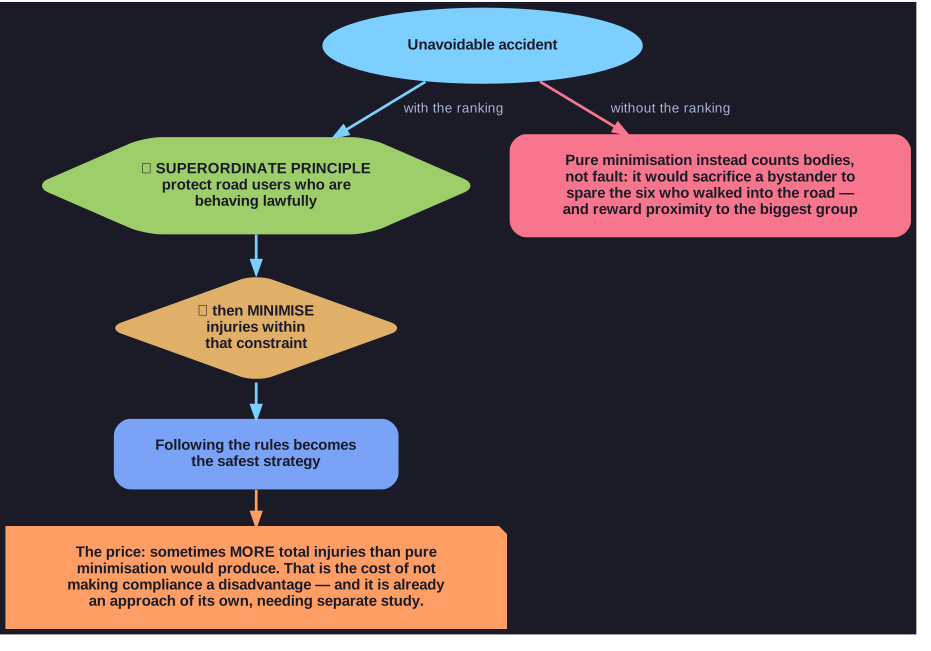
* Fault re-enters not as punishment but as a tie-break that comes first — at the price of more total injuries *
It is hard to address the fairness and incentive problems without departing quite far from the principle of injury minimisation. The proposal on the table is a lexical ordering of two principles: retain injury minimisation, but put a principle of protecting rule-compliant road users ahead of it as the superordinate principle.
In practice the vehicle would then still try to keep casualty numbers and the extent of injuries as low as possible, but would give precedence to protecting those acting in accordance with traffic rules. Fault re-enters the calculation not as a punishment but as a tie-break that comes first.
Two things to notice:
- It restores the right incentive. Following the rules becomes the safest strategy, which is what a traffic system needs to be true if its rules are to mean anything.
- It is honest about its cost. It will sometimes produce more total injuries than pure minimisation would, and that is the price of not making compliance a disadvantage.
The paper's own verdict is deliberately modest: this solution is basically already an approach of its own, and has to be investigated more closely elsewhere. That is the appropriate note to end on — the contribution is to show that pure injury minimisation is not defensible unmodified, not to settle what should replace it.
Go deeper:
 Wikipedia: Lexicographic preferences — the formal shape of »satisfy principle 1 first, optimise principle 2 only within it«.
- Ethics Commission: Automated and Connected Driving (Germany, 2017) — rules 7-9 take a position on exactly this ranking, and on what may never be programmed (English PDF).