Generative AI answers usually sound logical and well-reasoned — so why is "it sounds plausible" no evidence that the answer is actually correct?
Because a generative-AI tool is built to produce fluent, confident-sounding text, plausibility is a property of the wording, not of the facts — the very smoothness that makes an answer convincing is independent of whether it's true.
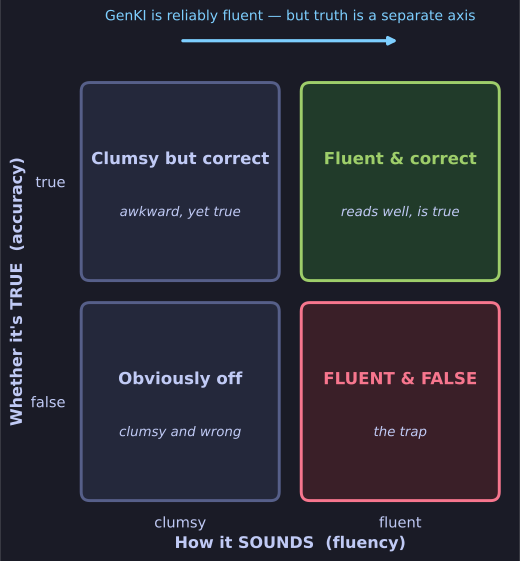
* Fluency and truth are two separate axes — GenKI reliably sounds fluent, but that says nothing about which row (true/false) an answer is in; the danger cell is fluent and false. *
Generative AI ("GenKI" — tools like ChatGPT or Gemini) works by predicting likely next words, so its output is optimised to read well: coherent, confident, tidily structured — whether or not the underlying claim is right.
- Fluency feels like competence. We instinctively treat a smooth, assured answer as a correct one, so the more plausible it sounds, the less we tend to check — the opposite of what the situation calls for.
- It can be confidently wrong. The same authoritative tone carries both true statements and fabricated ones — a "hallucination" is an invented fact or citation stated as if real — and nothing in the style tells the two apart.
- So "es tönt logisch und plausibel" (it sounds logical and plausible) carries essentially zero evidential weight about correctness: fluency and accuracy are independent.
The critical move is to flip the reflex: treat a polished, confident answer as a cue to verify, not to trust — check the claim against an independent source before accepting it, and the more convincing it sounds, the more deliberately.
Tip: Polish is a disguise, not a proof. If an AI answer feels too clean to doubt, that's exactly when to look it up.
Go deeper:
 Hallucination (artificial intelligence) — why a generative model can state a fabricated fact or citation with the same confidence as a true one.
- Automation bias — the documented tendency to over-trust output from an automated system, the reflex this card asks you to resist.