Question
When a student sharply and competently contradicts the teacher, why is that described as an "uncomfortable achievement of the goal" (unangenehme Zielerreichung)?
Answer
Because teaching critical thinking aims to produce independent thinkers — so a well-founded challenge is the goal succeeding, even though the same act lands as the teacher being publicly criticised.

* One event sits in both circles: a student's competent challenge is at once the goal being reached and the teacher being contradicted in public. *
The setup is a bind built into the job. A teacher of critical thinking wants students who reason for themselves and push back on the merits — including against authority. But the most visible proof that this worked is precisely a student standing up, in front of everyone, and dismantling something the teacher said:
- Studierende zeigen, dass sie kritisch, eigenständig denken — the goal — by Dozierende vor Publikum kritisieren (criticising the teacher in public). The success and the discomfort are the same event.
- So the better the teaching worked, the more the teacher gets contradicted — you can't have the outcome without the sting.
- The word kompetent is load-bearing: this is well-founded pushback, not reflexive contrarianism. Only reasoned dissent counts as the goal being reached; mere objecting-for-its-own-sake is noise, not evidence of independent thought.
So "competent dissent is uncomfortable goal-achievement" names the teacher's paradoxical position: the thing that stings is the thing they were trying to create.
Tip: It's the flip side of the other paradoxes — good critical-thinking teaching is supposed to bite the hand that taught it. If your students never challenge you, that's not comfort, it's a warning the goal isn't being reached.
Go deeper:
 Critical pedagogy (Paulo Freire) — the teaching tradition whose whole aim is learners who question authority, which is exactly why success looks like being challenged.
Note saved — thanks!
Question
Why is "dissent as a teaching goal" a paradox — what happens to disagreement once it's something you're expected to produce?
Answer
If contradicting the teacher is the assigned goal, then contradicting becomes obedience — the dissent stops being real dissent and turns into compliance with the instruction to dissent.
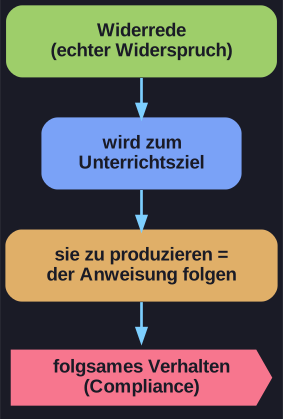
* Once dissent becomes the instruction, producing it is obeying — real Widerrede flips into folgsames Verhalten. *
The trap is structural. Genuine critical thinking shows up as Widerrede (dissent, talking back) — a learner challenging an authority on the merits. But the moment an institution makes "show me you can disagree" the explicit objective:
- Disagreeing is now what you were told to do, so producing it is folgsames Verhalten (compliant behaviour), not independence.
- The act looks identical from the outside, yet its meaning has flipped: it satisfies the authority rather than resisting it.
- You can't reliably tell performed dissent from real dissent, because the incentive now rewards the performance.
So "be critical because I'm grading you on it" quietly converts the very thing it asks for into its opposite. This is why critical thinking can't be fully commanded — only invited and made safe.
Tip: The tell is the reward structure. If disagreeing earns you marks or approval, ask whether you'd still hold the view when there's nothing to gain — that's the line between independent judgement and compliance dressed as rebellion.
Go deeper:
- Performative contradiction — the exact logical shape here: the act of obeying "be a dissenter" undercuts the dissent it's supposed to demonstrate.
Note saved — thanks!