Even if we agreed on injury minimisation in principle, what makes it hard to implement?
There is no non-arbitrary exchange rate between injuries — how many seriously injured equal one death, whether light injuries can be weighed against grave ones, and at what probability a risk of death counts as one.
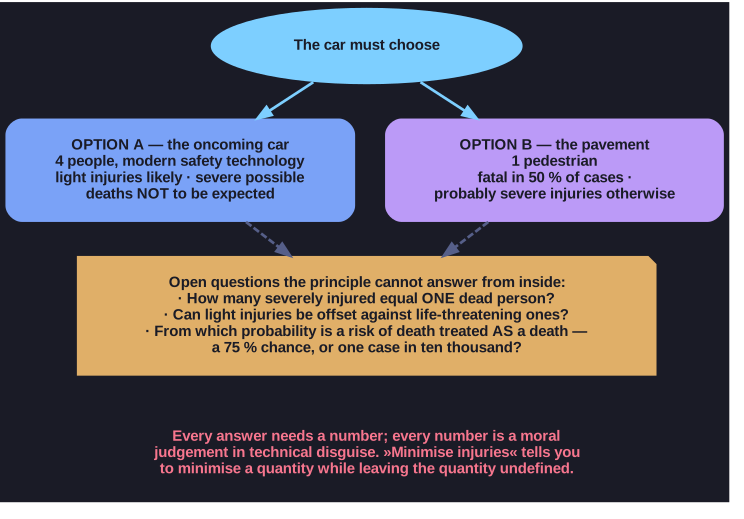
* The principle tells you to minimise a quantity while leaving the quantity undefined *
The illustrating case: an autonomous car can either drive into an oncoming car, endangering four people who, thanks to modern safety technology, have good chances of escaping severe or fatal injury — light injuries likely for each, severe injuries possible, deaths not to be expected. The only alternative is to swerve onto the pavement and run over a single pedestrian, which given the car's speed and braking distance ends fatally in 50 % of cases and probably causes severe injuries in the rest.
The questions this leaves open are the ones the theory cannot answer from inside:
- How should such injuries and risks be weighed against one another at all?
- How many severely injured people are equivalent to one dead person?
- Can light injuries be offset against severe or life-threatening ones — or are they different in kind?
- From which point is a serious risk of death to be treated as a death?
- Must it be a 75 % chance, or does one case in ten thousand suffice?
Every one of these needs a number, every number is a moral judgement wearing a technical disguise, and none of them can be derived from the principle "minimise injuries" itself. The principle tells you to minimise a quantity while leaving the quantity undefined.
That is the practical moral of the whole topic. Moving the decision from the driver's reflex to a design document does not make the moral problem go away — it makes it explicit, permanent and attributable, which is better, and forces someone to write down a number they would rather not write down.
Go deeper:
 Wikipedia: Value of a statistical life — how regulators already put a number on exactly this, and how uncomfortable the numbers look in daylight.