Quiz Entry - updated: 2026.07.30
Critical thinking can be framed as resting on four pillars. What are they?
It (1) presupposes cognitive abilities, (2) springs from epistemic attitudes/virtues, (3) holds to intellectual standards of argument, and (4) respects ethical/dialogical norms.
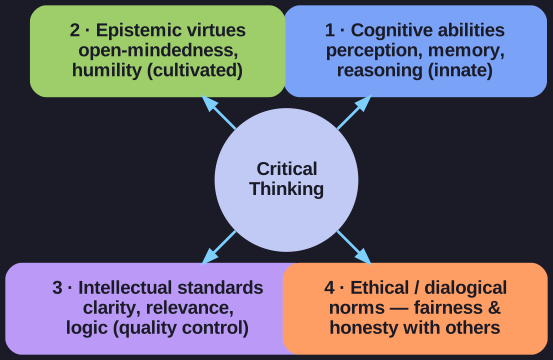
* The four pillars critical thinking rests on — abilities, virtues, standards, and dialogical norms. *
This is the central thesis that organises the whole topic — critical thinking is a kind of thinking that:
- …presupposes certain cognitive abilities (kognitive Fähigkeiten). The raw mental machinery — perception, memory, attention, reasoning — that has to function for any thinking to happen.
- …springs from epistemic attitudes or virtues (epistemische Haltungen/Tugenden). Cultivated character traits like open-mindedness, humility, curiosity that make your thinking good.
- …holds to intellectual standards of argument (intellektuelle Standards). Quality controls like clarity, accuracy, relevance, logic that the thinking must satisfy.
- …respects ethical/dialogical norms. How you reason with others — fairness, honesty in dialogue.
The first three are the focus of this topic; the dialogical (other-regarding) norms belong to a follow-on session.
Go deeper:
 Critical thinking (Stanford Encyclopedia of Philosophy) — abilities, dispositions and standards, in depth.
- Critical thinking (Wikipedia) — overview of the components and history.