Question
How did John Dewey define critical thinking, and what makes it different from irrational thinking?
Answer
Active, persistent and careful examination of a belief in the light of the reasons that support it and the further conclusions it leads to — thinking that meets standards of rationality.
John Dewey (the American philosopher, writing in 1910) gave the classic definition: critical thinking is the active, persistent and careful scrutiny of a belief — or a supposed piece of knowledge — examined two ways:
- backwards, in the light of the grounds that support it ("why should I believe this?"), and
- forwards, in the light of the further conclusions it leads to ("what follows if I accept it?").
The word "critical" here means it answers to certain principles, norms or standards of rationality. That is precisely what separates it from irrational thinking, which fails to meet those standards — or meets them only weakly. So critical thinking isn't a mood or a personality; it's thinking held accountable to explicit quality criteria.
Tip: Note the two directions — grounds behind and consequences ahead. A belief that has no support behind it, or that you've never followed forward to see what it commits you to, hasn't been thought through.
Go deeper:
 John Dewey — the American philosopher who gave the classic 1910 definition.
- Critical thinking (Stanford Encyclopedia of Philosophy) — a rigorous survey that opens with Dewey's definition.
Note saved — thanks!
Question
Critical thinking can be framed as resting on four pillars. What are they?
Answer
It (1) presupposes cognitive abilities, (2) springs from epistemic attitudes/virtues, (3) holds to intellectual standards of argument, and (4) respects ethical/dialogical norms.
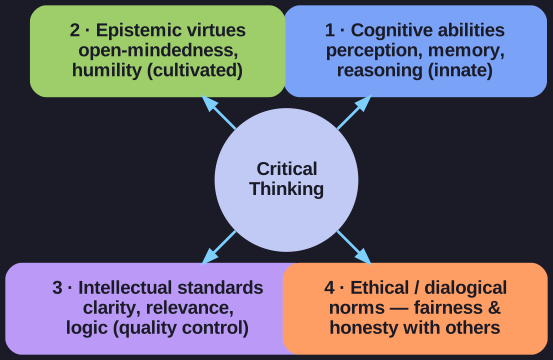
* The four pillars critical thinking rests on — abilities, virtues, standards, and dialogical norms. *
This is the central thesis that organises the whole topic — critical thinking is a kind of thinking that:
- …presupposes certain cognitive abilities (kognitive Fähigkeiten). The raw mental machinery — perception, memory, attention, reasoning — that has to function for any thinking to happen.
- …springs from epistemic attitudes or virtues (epistemische Haltungen/Tugenden). Cultivated character traits like open-mindedness, humility, curiosity that make your thinking good.
- …holds to intellectual standards of argument (intellektuelle Standards). Quality controls like clarity, accuracy, relevance, logic that the thinking must satisfy.
- …respects ethical/dialogical norms. How you reason with others — fairness, honesty in dialogue.
The first three are the focus of this topic; the dialogical (other-regarding) norms belong to a follow-on session.
Go deeper:
- Critical thinking (Stanford Encyclopedia of Philosophy) — abilities, dispositions and standards, in depth.
- Critical thinking (Wikipedia) — overview of the components and history.
Note saved — thanks!