Quiz Entry - updated: 2026.07.30
Contrast the Oracle and Reverse Oracle patterns along direction, who initiates, and what's on-chain.
They are mirror images: an oracle feeds outside facts into on-chain contracts; a reverse oracle lets outside systems consult on-chain contracts.
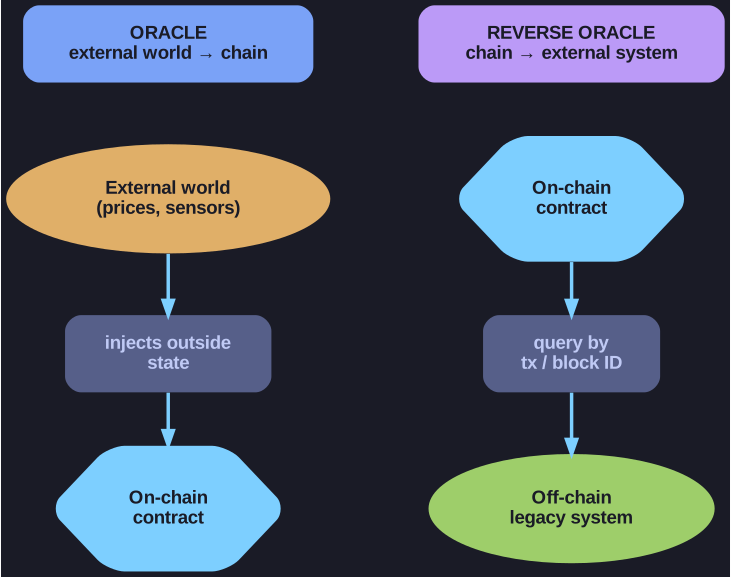
* Same bridge, opposite arrows — the chain is the sink for an oracle, the source for a reverse oracle. *
| Dimension | Oracle | Reverse Oracle |
|---|---|---|
| Data direction | External world → chain | Chain → external system |
| Who initiates | On-chain contract needs external state | Off-chain system needs on-chain data/checks |
| Where validation runs | Oracle checks external state, feeds validator | Smart contract validates; off-chain component queries by ID |
| Primary goal | Let contracts act on real-world facts | Add chain guarantees to legacy systems non-intrusively |
| Key risk | Trusting the oracle; injected state unverifiable | May not stay non-intrusive if system can't be extended |
The single idea: pick the arrow that matches where the decision lives. If a contract must decide using outside data, use an oracle; if outside software must decide using chain data, use a reverse oracle.
Go deeper:
 Blockchain oracle (Wikipedia) — inbound oracles in depth; the reverse direction is the same bridge read the other way, from an existing system into the chain.