Can an autonomous vehicle itself be a moral agent — the decision-maker in an accident?
No. Nothing is decided in the seconds before the crash; the real decision was taken when the programming was chosen, so the people who made those choices are the agents.
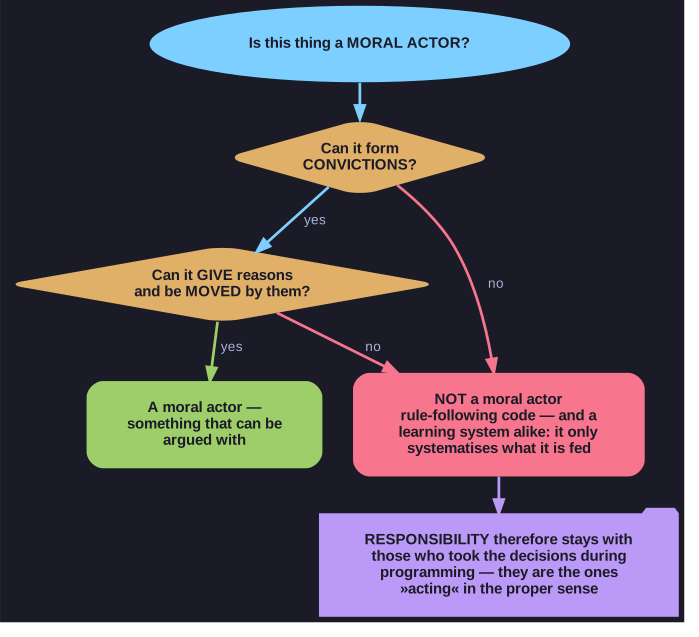
* Ask who could have been persuaded to do otherwise; that is where the responsibility sits *
The first fundamental difference from a classic trolley problem is one of timing: in the actual situation immediately before the accident, no decisions can be made any more. The car executes. The decision about how an autonomous car behaves is taken when its programming is decided.
Why the vehicle is not a moral actor:
- As long as autonomous vehicles simply follow their programming and are unable to form convictions and to let themselves be moved by reasons, it makes no sense to perceive them as moral actors. This is obvious where the car merely implements rules that were coded into it directly.
- The same holds for a machine-learning system. An artificial intelligence likewise has no convictions and can neither give reasons nor be affected by them — it systematises the information it is fed.
Therefore responsibility for the behaviour of autonomous cars stays with those who took the relevant decisions during programming. They are the ones "acting" in the proper sense of the word.
Note the criterion being used, because it does real work beyond cars: moral agency requires the capacity to hold beliefs and to be moved by reasons — to be the kind of thing that can be argued with. A system that produces outputs, however sophisticated, does not thereby acquire it. This is the standard reason why "the algorithm decided" is not a defence: it relocates a decision that was made by identifiable people, at design time, with time to think.
Tip: Ask who could have been persuaded to do otherwise. That is where the responsibility sits.
Go deeper:
 Ethics Unwrapped: Moral Agent — the criterion in one page: what a thing has to be capable of before it can be blamed.
- Wikipedia: Ethics of artificial intelligence — the responsibility-gap debate — who answers when a learned system does something nobody specified.