Business ethics in the broad sense operates on three levels. What sits on each?
The surrounding system (the rules of the game), the company (how it governs itself), and the person (how individuals act inside it).
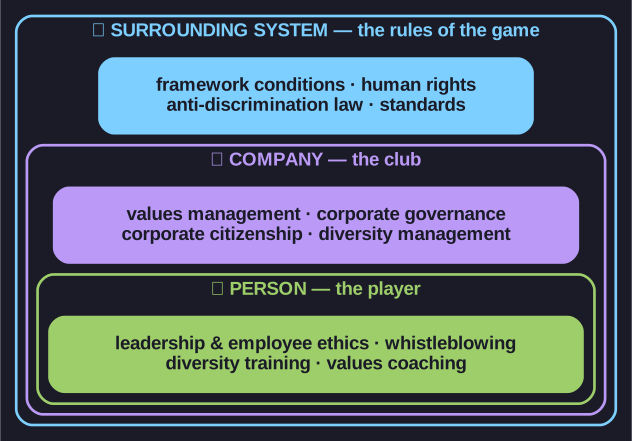
* Nested, not parallel — a problem at one level cannot be fixed at another *
- Level of the surrounding system (Umsystem) — the framework conditions: laws and general guidelines and standards, up to and including human rights and anti-discrimination law. This is the level at which the playing field is defined, and largely not the firm's to set.
- Level of the company — values management, corporate governance, corporate citizenship and diversity management. Corporate citizenship means a firm's societal engagement: donations, sponsoring, corporate volunteering.
- Personal level — leadership and employee ethics, whistleblowing, diversity training and values coaching.
The reason to keep the levels apart is that they fail in different ways and need different fixes. A problem at the system level (a market where everyone must cut the same corner to survive) cannot be fixed by exhorting individuals — that just penalises the honest ones. A problem at the personal level cannot be fixed by writing another policy. And the company level exists precisely to translate between the two: it is where framework obligations become concrete internal rules, and where individual concerns can be escalated into structural change.
Tip: Rules of the game (system) → the club (company) → the player (person). Ask which level a proposed fix acts on, and whether that is the level where the problem actually sits.
Go deeper:
 Wikipedia: Corporate governance — the company-level machinery: who controls the controllers, and how boards are meant to work.