A ransomware attack on a Swiss dairy farmer ended with a dead cow. How did an encrypted office computer kill an animal?
The milking robot kept running, but the farmer lost access to its data — so nobody noticed that a pregnant cow had stopped coming to be milked; the calf died in the womb and the cow had to be put down.
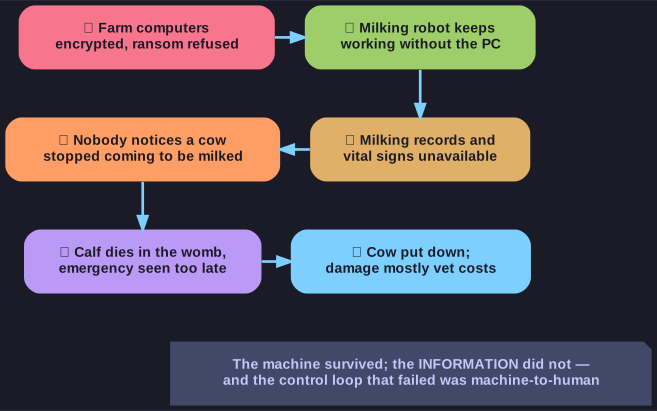
* The robot survived the attack; the information did not — and the control loop that broke was machine-to-human. *
The case, in the canton of Zug and reported in August 2024, is worth knowing in detail because the causal chain is so unlike the usual ransomware story:
- Criminals encrypted the computers of dairy farmer Vital Bircher and demanded roughly $10,000 for decryption. He decided not to pay, and the attackers got nothing.
- The milking robot itself kept working without the computer and network connection. The cows were still milked. Judged on the machinery, the attack had failed.
- What was lost was the data: milking records and the vital signs of the pregnant cows. Nobody could see any longer that one cow had stopped coming to the robot.
- That cow's calf died in the womb. Because the systems were down, the farmer recognised the emergency too late; the calf could not be saved and the cow had to be euthanised.
- Monetary damage came to over €6,400, mostly vet costs and a replacement computer — a figure that says nothing about the actual loss.
Why it belongs in an architecture discussion:
- Availability of information is a safety property, not a comfort property. The control loop that failed was not machine-to-machine; it was machine-to-human. Losing the monitoring data disabled the farmer's ability to act, and there was no fallback because nobody had ever modelled that path as security-relevant.
- The cyber-physical blast radius is not bounded by the encrypted device. Classic impact analysis would have recorded "office PC encrypted, restore from backup, one day lost".
- Small operators are in scope. Surveys of digitalisation in agriculture have repeatedly found awareness, knowledge and clear responsibility lacking — with farmers themselves naming IT security worries as one of the biggest obstacles to digitalising further.
Tip: when you assess a system's protection needs, ask not only "what happens if this data leaks" but "who is relying on seeing this data, and what do they fail to notice if it goes dark?"
Go deeper:
 heise online — Switzerland: cow and calf die after cyberattack — the original report, with the ransom demand, the refusal and the final damage figure.