Question
Why is the Security Development Lifecycle (SDLC) considered mandatory, not optional?
Answer
Because skipping it turns security into a gamble — and against real attackers, an unmodelled product is one you're statistically sure to lose.
The SDL (Security Development Lifecycle) bakes security into every stage of building software instead of bolting it on at the end. The guiding maxim: "the earlier the better, but never too late, and never ignore it" — catching a flaw in design costs a fraction of catching it after release.
It grew out of Microsoft's 2002 "Trustworthy Computing" initiative: after a run of high-profile worms and vulnerabilities, Bill Gates sent a company-wide memo making security the top priority over new features across all Microsoft products. The SDL is the concrete process that came out of that mandate.
Note saved — thanks!
Question
What are the seven phases of Microsoft's Security Development Lifecycle (SDL)?
Answer
Training → Requirements → Design → Implementation → Verification → Release → Response — five core phases bracketed by upfront Training and post-ship Response.
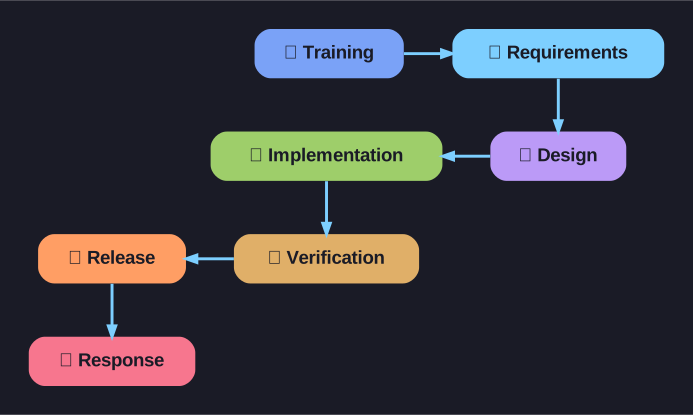
* Microsoft SDL — Training, Requirements, Design, Implementation, Verification, Release, Response. *
| Phase | Focus |
|---|---|
| Training | Security education for developers |
| Requirements | Define security/privacy requirements, assign Security Advisor |
| Design | Threat modeling, attack surface analysis |
| Implementation | Secure coding, static analysis, banned APIs |
| Verification | Security testing, fuzz testing, penetration testing |
| Release | Final security review, incident response plan |
| Response | Handle security incidents post-release |
Supporting pillars: Education, Process, Accountability
Mnemonic: "TRaDe In VeRy Rare" - Training, Requirements, Design, Implementation, Verification, Release, Response
Go deeper:
 Microsoft Security Development Lifecycle — the five core phases bracketed by Training and Response.
Note saved — thanks!