Question
Why wasn't security a priority in the original design of the internet?
Answer
It grew out of ARPANET, a small closed network of trusted academic/military institutions, so the designers optimised for sharing — not defending against malicious users.
The internet evolved from ARPANET — a network of trusted academic and military institutions. The designers assumed:
- All users were known and trustworthy
- The network was closed and controlled
- The goal was information sharing, not protection
This resulted in protocols (HTTP, SMTP, FTP, DNS) with no built-in authentication or encryption - because in a trusted network, why would you need them?
Modern consequence: We now run these inherently insecure protocols on a global network with anonymous users and malicious actors. Security has to be bolted on (HTTPS, SMTPS, DNSSEC) rather than being fundamental to the design.
Go deeper:
 History of the Internet (Wikipedia) — how ARPANET's small, trusted network grew into the open internet, and why security was retrofitted.
![Internet users in 2023 as a percentage of a country's populationSource: International Telecommunication Union.[160]](https://upload.wikimedia.org/wikipedia/commons/thumb/9/99/InternetPenetrationWorldMap.svg/960px-InternetPenetrationWorldMap.svg.png)
Note saved — thanks!
Question
What distinguishes a worm from a virus from a trojan?
Answer
Virus needs a host file, worm self-replicates over networks, trojan deceives the user into installing it.
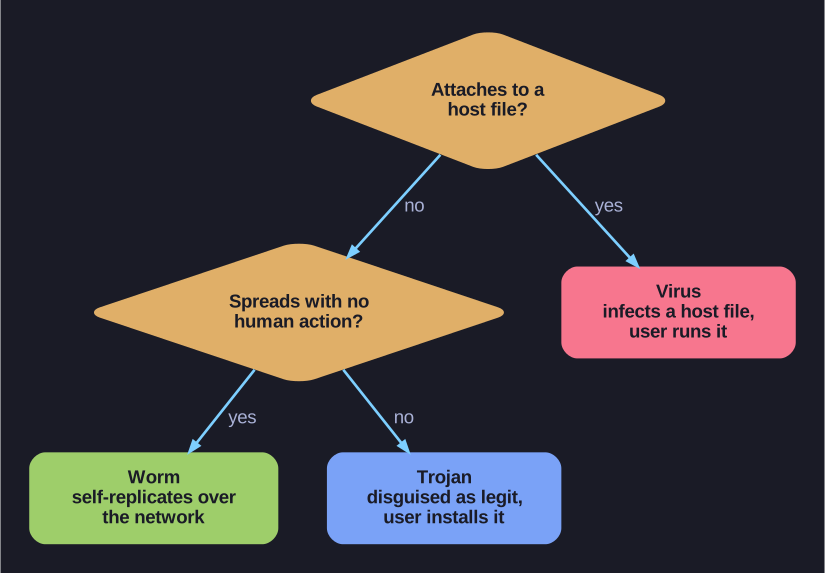
* Virus vs worm vs trojan — a host file plus a user makes it a virus; self-spreading with no human is a worm; disguised software the user installs is a trojan. *
| Property | Virus | Worm | Trojan |
|---|---|---|---|
| Host file needed | Yes (attaches to exe/doc) | No (standalone) | No (IS the file) |
| Self-replicates | Yes (via infected files) | Yes (over network) | No |
| Spreads how | Shared/executed files | Exploits vulnerabilities automatically | User tricked into installing |
| Human action needed | Yes (run infected file) | No (autonomous) | Yes (install fake software) |
| Named after | Biological virus | Worm (crawls through network) | Greek Trojan Horse |
Tip: The key question is "does it need help?" — viruses and trojans need human action, worms don't.
Go deeper:
- Malware (Wikipedia) — the full malware family (virus, worm, trojan, ransomware, spyware) and how each spreads.

Note saved — thanks!