Question
What are the four main classes of computers?
Answer
Personal, server, supercomputer, and embedded — spanning everyday machines down to the hidden controllers in cars and appliances.
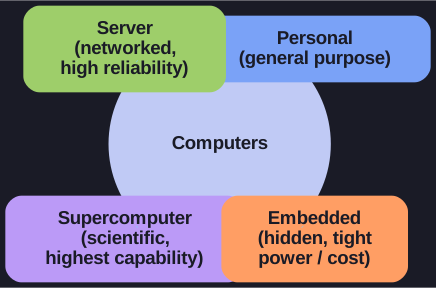
* Computers fall into four broad classes that trade off capability, reliability, and cost. *
| Class | Characteristics |
|---|---|
| Personal computers | General purpose, variety of software, cost/performance tradeoff |
| Server computers | Network-based, high capacity/performance/reliability, range from small servers to large data centers |
| Supercomputers | High-end scientific/engineering calculations, highest capability but small market share |
| Embedded computers | Hidden components of systems (cars, appliances, IoT), stringent power/performance/cost constraints |
Go deeper:
 Classes of computers (Wikipedia) — the full taxonomy (personal/micro, server, mainframe/supercomputer, embedded) by purpose, function and scale.
- Embedded system (Wikipedia) — the least-familiar of the four classes: dedicated-function computers with processor, memory and I/O baked into a larger device.

Note saved — thanks!
Question
What are the typical components found on a modern smartphone's main board?
Answer
A system-on-chip (SoC) processor plus RAM, flash storage, power-management chips, and a cluster of wireless and sensor modules.
Modern phones squeeze nearly the whole computer onto a few chips: the SoC fuses CPU, GPU, and modems on one die, and the RAM is often stacked directly on top of the processor (package-on-package) to save board space.
Typical components (a Samsung Galaxy S20 Ultra teardown as example):
- Processor: Qualcomm Snapdragon 865 (8 cores) with integrated GPU
- Memory: 12 GB Samsung LPDDR5 RAM, overlaid on the processor
- Storage: 128 GB Samsung flash storage
- Power: Maxim power-management IC, Qualcomm power-amplification modules
- Wireless: Qualcomm 5G modem, Skyworks RF module, Qorvo WiFi module
- Sensors / radios: on the newer S25 Ultra teardown a separate RF board adds an NFC controller, ultra-wideband transceiver, an STMicroelectronics 6-axis accelerometer & gyroscope, a Bosch pressure sensor, and an AKM magnetometer
Go deeper:
- System on a chip (Wikipedia) — how a phone's SoC bundles CPU, GPU, memory controllers, caches, modem/RF and camera blocks onto one die, with real examples (Snapdragon, Exynos).

Note saved — thanks!