Question
What are the three main stages a face-recognition system runs through to identify a person?
Answer
Face detection (find the face), landmark detection (locate key points like eyes/nose/jaw), then recognition (identify, verify, or analyse attributes).
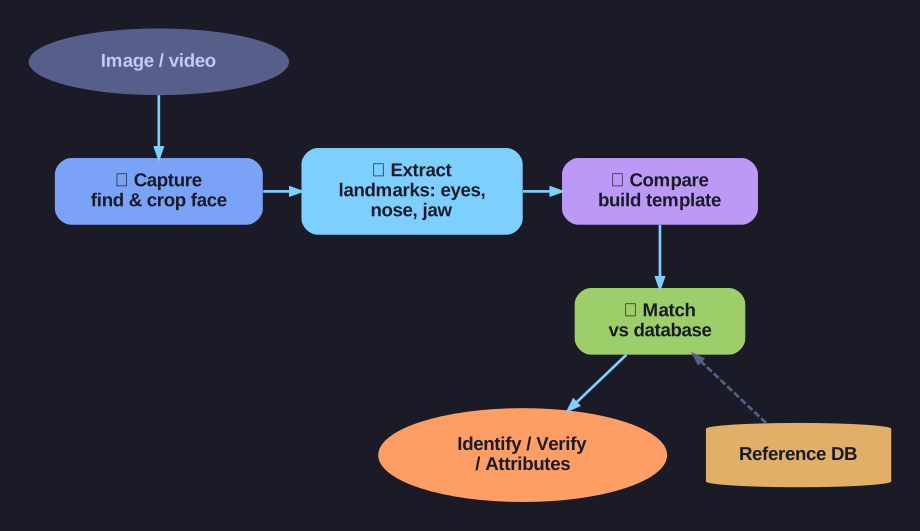
* The face-recognition pipeline — capture, extract, compare, match. *
Face recognition works by systematically analysing the visible features of the frontal head and turning them into a unique biometric profile:
- Face finding (Gesichtsfindung): the system first locates faces in an image or video stream and crops the relevant region.
- Reference-point detection (Referenzpunktdetektion): algorithms identify salient facial points — eyes, nose, mouth corners, jaw contour.
- Recognition (Gesichtserkennung): the final analysis covers identification ("Who is this person?"), verification ("Is this person X?"), and attribute analysis (age, gender, emotion).
Tip: Identification is 1-to-many (search a database); verification is 1-to-1 (does this face match the claimed identity?). They sound similar but are very different problems.
Go deeper:
 Facial recognition system (Wikipedia) — the detect→align→extract→match pipeline.
Note saved — thanks!
Question
What does a face-recognition system fundamentally do, in biometric terms?
Answer
It transforms a face into a digital signature and matches it against a reference database to verify or identify a person.
A face-recognition system is a biometric technology that detects human faces in digital images or video streams and compares them against a reference database. The standard pipeline is Capturing → Extracting → Comparing → Matching: capture the image, extract the unique facial features, compare against stored templates, and report a match.
It is primarily used for user authentication: it measures and analyses unique facial features to verify a person's identity. Put another way, face recognition "transforms biometric features into digital signatures that can identify people with high precision."
Tip: The "match against a reference database" step is the privacy-critical part — without a stored database of faces, recognition (as opposed to mere detection) is impossible.
Go deeper:
- Facial recognition system (Wikipedia) — the capture→extract→compare→match flow and identification-vs-verification.
Note saved — thanks!