Question
What does PAO stand for, and what is the system?
Answer
Person–Action–Object: every item you memorise gets a fixed person, a fixed action, and a fixed object — so you can fuse several items into one scene.
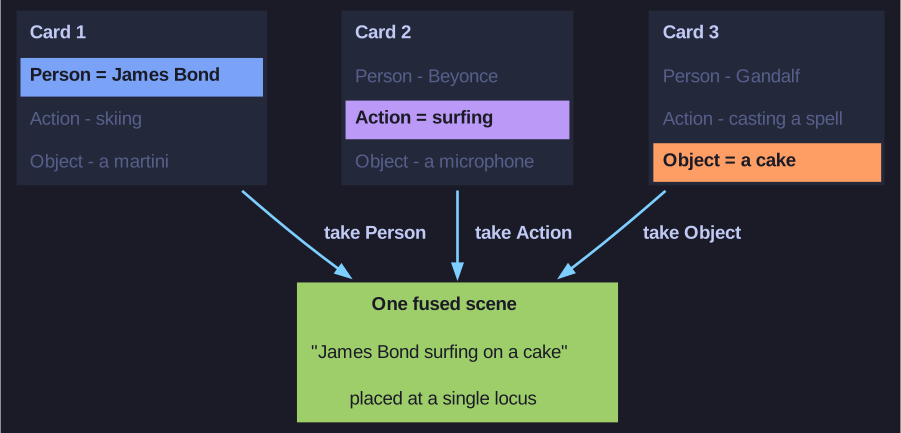
* Each card owns a full Person/Action/Object — the composite takes the Person of card 1, Action of card 2, Object of card 3, and drops the rest. *
You assign each of your items (each playing card, or each number 00–99) a permanent three-part identity. Once every item has its own Person, Action and Object, you can build a composite image by mixing slots from different items — the Person of one, the Action of another, the Object of a third — packing three items into a single picture. That fusion is the whole point of PAO.
Go deeper:
 PAO within the peg-system family (Wikipedia) — places PAO among the classic peg systems.
Note saved — thanks!
Question
What are the three slots in a PAO image?
Answer
A Person (who), an Action (what they're doing), and an Object (the thing they act on).
Each item owns all three, e.g. one card might be Person: Einstein, Action: juggling, Object: a violin. In a composite, each slot can come from a different item:
- Person — a distinct, vivid character (celebrity, character, someone you know).
- Action — a clear verb, ideally that person's signature move.
- Object — a concrete thing they interact with.
Fixed roles in a fixed order are what let you decode the scene back later.
Go deeper:
- Mnemonic peg system (Wikipedia) — the standard person/action/object triad with worked examples.
Note saved — thanks!