Question
What is the full method for memorising a shuffled deck of cards?
Answer
Turn groups of cards into PAO composites, place each composite at successive loci in a palace, then walk the palace to read the order back.
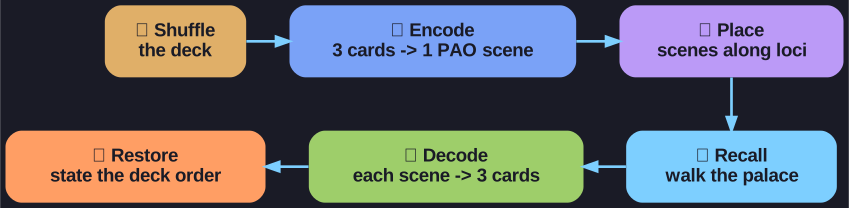
* The full method, end to end: shuffle, encode triples, place, recall, decode, restore. *
The pipeline, end to end:
- Encode — flip the deck in order, fusing each group of three cards into one Person-Action-Object image.
- Place — drop each composite at the next locus of a rehearsed palace.
- Recall — walk the palace, decode each composite back into its three cards, and name them in sequence.
Two tools, one pipeline: PAO compresses and encodes, the palace stores and orders.
Go deeper:
 Method of loci (Wikipedia) — the palace half of the pipeline; lists shuffled decks as a competition use.
 Nelson Dellis — How to memorize a full deck — the exact encode-place-recall pipeline demonstrated.

Note saved — thanks!
Question
How many loci do you need for a full 52-card deck?
Answer
About 18 with triples (three cards per image) — or 26 with pairs (two per image).
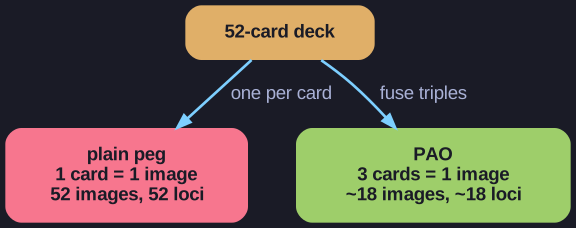
* PAO cuts the palace to ~1/3: ~18 loci for 52 cards instead of 52. *
The compression sets the locus count:
- Triples: 52 ÷ 3 ≈ 18 composites → ~18 loci.
- Pairs: 52 ÷ 2 = 26 composites → 26 loci.
So a modest palace handles a whole deck. That's the payoff of PAO: without it you'd need 52 loci (one per card); with triples you need roughly a third as many.
Go deeper:
- Memory sport (Wikipedia) — competitors use PAO/Dominic to compress the locus count.

Note saved — thanks!