Question
How does PAO memorise long numbers?
Answer
With a 00–99 PAO, read six digits per image — first pair = Person, second = Action, third = Object.
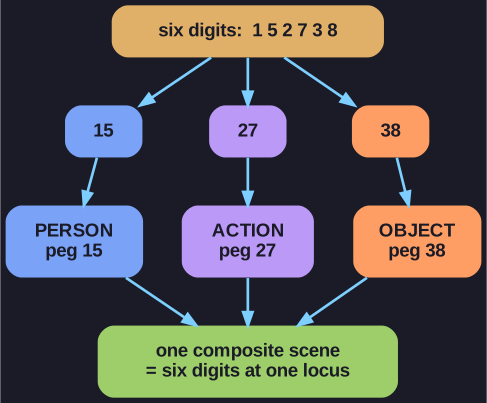
* Six digits become one scene: pairs 15/27/38 map to Person/Action/Object at one locus. *
Exactly like cards, but the "items" are 2-digit numbers. Chunk the number into sixes: 15 27 38 → Person 15, Action 27, Object 38 → one composite. Place composites along a palace and you can hold hundreds of digits with a manageable number of images. This is the standard competitive method for the "spoken numbers" and "numbers" disciplines — six digits per locus instead of one or two.
Go deeper:
 Nelson Dellis — How to create a 2-digit PAO system — building the 00–99 PAO that reads six digits per image.
 Numeric PAO (Wikipedia) — the six-digits-per-image example.
Note saved — thanks!
Question
Besides cards and numbers, what else can PAO encode?
Answer
Anything reducible to your number/card items — binary (via conversion), dates, phone numbers, PINs, IDs.
If you can map information onto your existing PAO set, PAO can carry it:
- Binary — convert bits to decimal, then use the number PAO.
- Dates / years — encode the digits.
- Phone numbers, PINs, account numbers — chunk and encode as numbers.
You don't build a new system per task; you funnel everything through the one PAO you already drilled. Reuse is the point.
Go deeper:
- Mnemonic major system (Wikipedia) — how dates, PINs and phone numbers reduce to the same sounds-to-images path.
![Mnemonic major system by Pierre Hérigone from 1634[14]](https://upload.wikimedia.org/wikipedia/commons/4/42/Pierre_H%C3%A9rigone_%281580_-_1634%29_-_Cursus_mathematicus%2C_volume_2%2C_top_of_page_137.png)
Note saved — thanks!