Question
Why is redundancy important in a Layer 2 switched network, and what problem does it introduce?
Answer
Redundancy eliminates single points of failure, but it introduces the risk of Layer 2 loops.
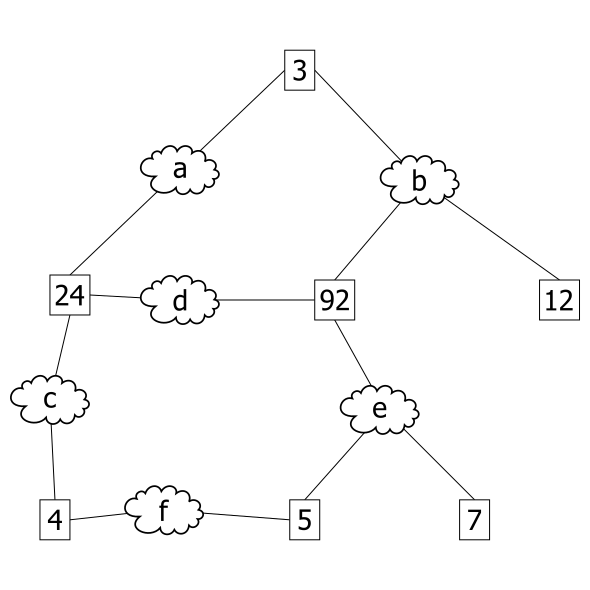
* Redundant bridged topology with physical loops. — GhosT, CC BY 3.0, via Wikimedia Commons. *
Redundancy is a key part of hierarchical network design. By having alternate physical paths, users can still access network resources even if one link fails.
The catch: Redundant paths in a switched Ethernet network can cause both physical and logical Layer 2 loops. Unlike Layer 3 (where TTL (Time to Live) prevents infinite forwarding), Ethernet has no built-in mechanism to stop frames from circling forever.
Ethernet LANs (Local Area Networks) require a loop-free topology with a single active path between any two devices. Without one, frames propagate endlessly until a link is disrupted.
Tip: Think of it like having two hallways between two rooms — great for evacuation, but if you're passing a note in a circle, it never stops unless someone blocks one hallway.
Go deeper:
 Switching loop (Wikipedia) — how redundant L2 paths spawn loops, MAC (Media Access Control)-table instability and broadcast storms (no TTL to save you).
Note saved — thanks!
Question
What is the Spanning Tree Protocol (STP) and how does it solve the Layer 2 loop problem?
Answer
STP is a loop-prevention protocol that creates a loop-free Layer 2 topology while still allowing physical redundancy.
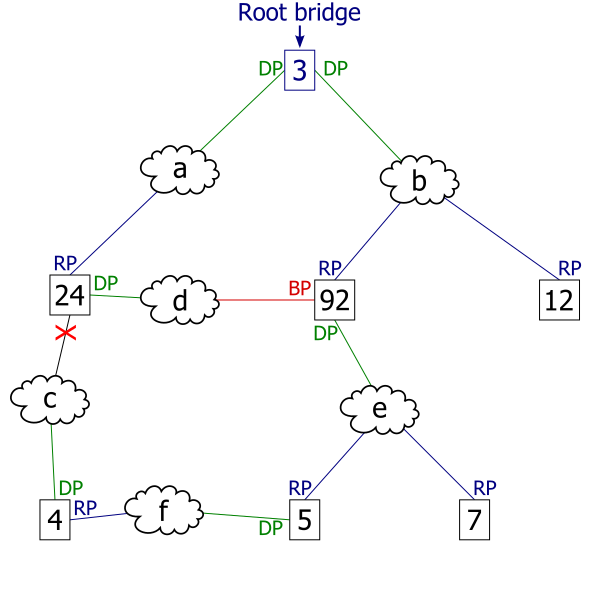
* Loop-free tree after STP blocks redundant links. — GhosT, CC BY 3.0, via Wikimedia Commons. *
STP works by logically blocking certain ports on switches so that only one active path exists between any two devices. The physical links are still there — they're just not forwarding data frames.
Key behaviors:
- Allows redundant physical connections (for failover)
- Logically disables redundant paths to prevent loops
- Blocked ports still receive BPDUs (Bridge Protocol Data Units — control messages) but don't forward user data
- Defined in IEEE 802.1D
In the diagram, S2's port connecting to Trunk2 is blocked (shown with an X). Frames from PC1 travel through S3 → S1, not through the direct redundant link. S2 drops frames received on the blocked port.
Go deeper:
 Spanning Tree Protocol (Wikipedia) — canonical end-to-end reference: loop prevention, BPDUs, root election, port states and all variants in one place.

Note saved — thanks!