Question
What are the three methods for dynamically assigning an IPv6 GUA (Global Unicast Address) to a host, and how do they differ?
Answer
SLAAC (Stateless Address Autoconfiguration) only (stateless, no server), SLAAC with stateless DHCPv6 (Dynamic Host Configuration Protocol version 6) (address from SLAAC, extra info from server), and stateful DHCPv6 (everything from server).
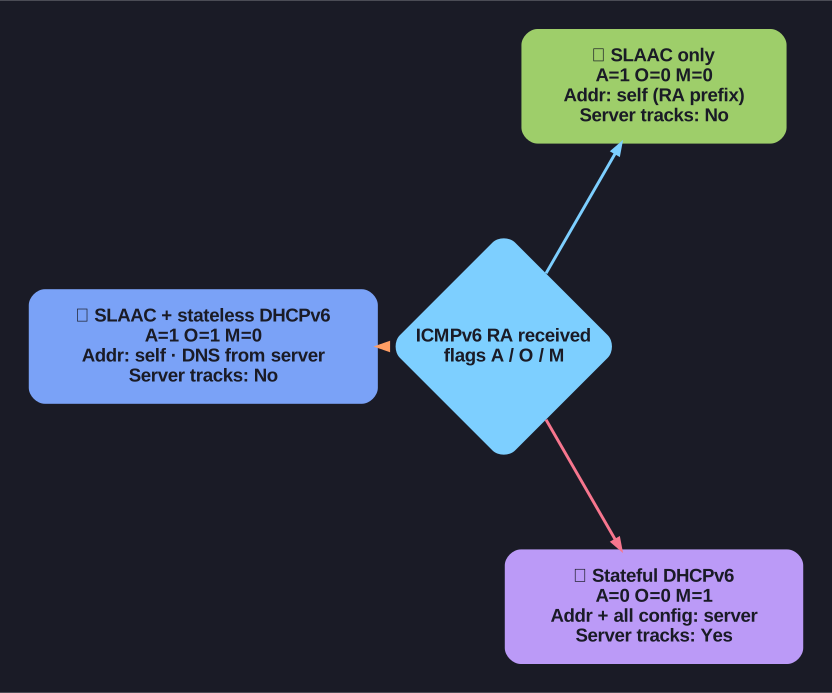
* Three IPv6 GUA assignment methods by RA (Router Advertisement) flags. *
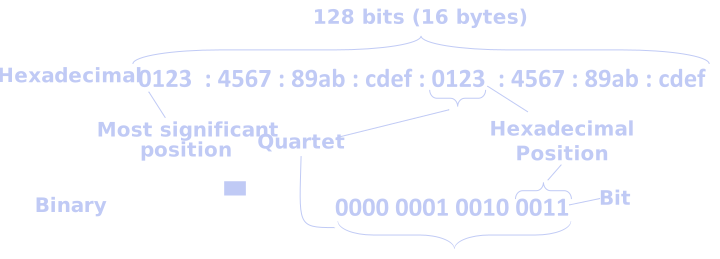
* IPv6 global unicast address structure. — Michel Bakni, CC BY-SA 4.0, via Wikimedia Commons. *
The three GUA assignment methods compared:
| Method | Address Source | Other Info Source | Server Tracks Addresses? |
|---|---|---|---|
| SLAAC Only | Host creates its own GUA from RA prefix | RA message (DNS (Domain Name System), MTU (Maximum Transmission Unit), gateway) | No |
| SLAAC + Stateless DHCPv6 | Host creates its own GUA from RA prefix | DHCPv6 server (DNS, domain name) | No |
| Stateful DHCPv6 | DHCPv6 server assigns the GUA | DHCPv6 server (everything) | Yes |
Key concepts:
- All three methods start with ICMPv6 (Internet Control Message Protocol version 6) Router Advertisement (RA) messages — the RA tells the host which method to use
- "Stateless" means no server is keeping track of which IPv6 addresses are assigned to which clients
- "Stateful" means the DHCPv6 server maintains a binding table of address-to-client mappings (like DHCPv4 (Dynamic Host Configuration Protocol version 4))
Tip: Think of it as a spectrum: SLAAC only = fully autonomous, stateless DHCPv6 = autonomous addressing + server extras, stateful DHCPv6 = server controls everything.
Go deeper:
 IPv6 address (Wikipedia) — covers SLAAC, stateful/stateless DHCPv6 and how GUAs are formed from prefix + interface ID.

Note saved — thanks!
Question
What are the three flags in an ICMPv6 (Internet Control Message Protocol version 6) RA (Router Advertisement) message, and what does each one tell the host to do?
Answer
A flag = use SLAAC (Stateless Address Autoconfiguration) for addressing, O flag = get other config from DHCPv6 (Dynamic Host Configuration Protocol version 6), M flag = get managed (full) config from DHCPv6.
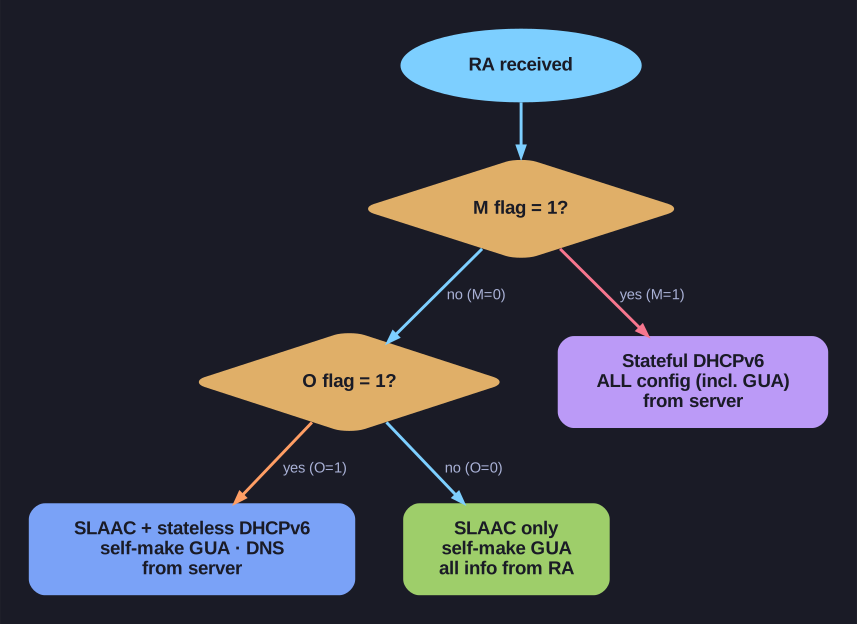
* RA flag decision tree (M then O). *
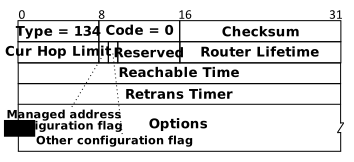
* ICMPv6 Router Advertisement message format. — Michel Bakni, CC BY-SA 4.0, via Wikimedia Commons. *
| Flag | Name | When Set to 1 |
|---|---|---|
| A | Address Autoconfiguration | Host should use SLAAC to create its own IPv6 GUA (Global Unicast Address) |
| O | Other Configuration | Host should contact a stateless DHCPv6 server for additional info (DNS (Domain Name System), domain name) |
| M | Managed Address Configuration | Host should contact a stateful DHCPv6 server for all IPv6 config |
Flag combinations and their meaning:
| A | O | M | Method |
|---|---|---|---|
| 1 | 0 | 0 | SLAAC only (default) |
| 1 | 1 | 0 | SLAAC + Stateless DHCPv6 |
| 0 | 0 | 1 | Stateful DHCPv6 only |
Tip: A = Address yourself, O = get Other stuff from a server, M = let the server Manage everything. The default is A=1, O=0, M=0 — pure SLAAC.
Go deeper:
- RFC 4861 — Neighbor Discovery for IPv6 — defines the M, O (RA header) and A (prefix option) flags normatively.
Note saved — thanks!