Question
What is DHCPv4 (Dynamic Host Configuration Protocol v4) and why is it important for network administration?
Answer
DHCPv4 dynamically assigns IPv4 addresses and network configuration to clients, eliminating the need for manual IP (Internet Protocol) assignment.
What DHCPv4 provides to clients:
- IPv4 address
- Subnet mask
- Default gateway
- DNS (Domain Name System) server address(es)
- Domain name
- Lease duration
Key concepts:
- Works on a client/server model — clients request, servers assign
- Addresses are leased, not permanently assigned — they expire after a configurable period (typically 24 hours to a week)
- When a lease expires, the client must request a new address (usually gets the same one back)
- The lease mechanism ensures addresses from disconnected/powered-off devices are returned to the pool
DHCPv4 server options:
- Dedicated server — scalable, common in enterprise networks
- Cisco router — can run a full DHCPv4 server via IOS, ideal for small branch/SOHO sites
Go deeper:
 Dynamic Host Configuration Protocol (Wikipedia) — the client/server lease model and why dynamic assignment replaces manual config.
- RFC 2131 — DHCP — the spec defining leases, the address pool, and the parameters a server supplies.

Note saved — thanks!
Question
What are the four steps of the DHCP (Dynamic Host Configuration Protocol) lease process (DORA), and which messages are broadcast vs. unicast?
Answer
Discover (broadcast), Offer (unicast), Request (broadcast), Acknowledge (unicast) — remember: DORA (Discover, Offer, Request, Acknowledge).
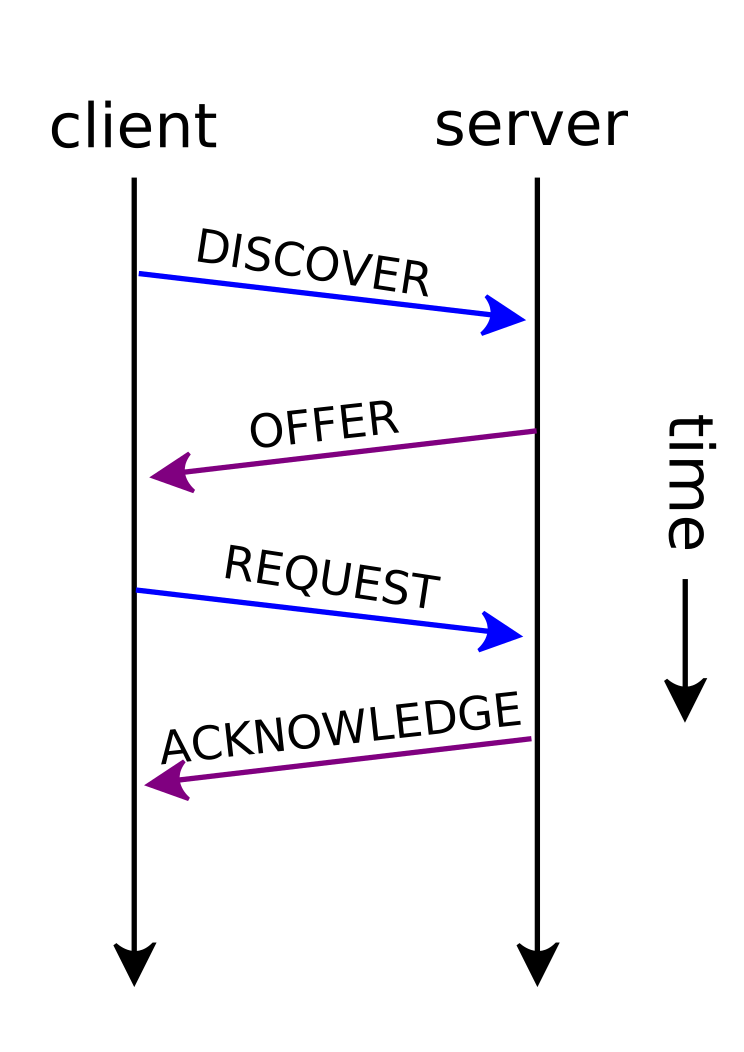
* The DHCP DORA message exchange. — Gelmo96, CC BY-SA 4.0, via Wikimedia Commons. *
| Step | Message | Direction | Type |
|---|---|---|---|
| 1 | DHCPDISCOVER | Client → Server | Broadcast |
| 2 | DHCPOFFER | Server → Client | Unicast |
| 3 | DHCPREQUEST | Client → Server | Broadcast |
| 4 | DHCPACK | Server → Client | Unicast |
Why each step matters:
- Discover — Client has no IP (Internet Protocol) yet, so it broadcasts "Is there a DHCP server out there?" (destination 255.255.255.255)
- Offer — Server responds with an available IP address and configuration parameters
- Request — Client broadcasts its acceptance (broadcast so other DHCP servers know the client chose a different server)
- Acknowledge — Server confirms the lease and the client can start using the IP
Note: Per RFC 2131, the Offer and Acknowledge can also be sent as broadcast in some implementations.
Tip: Remember DORA — Discover, Offer, Request, Acknowledge. The pattern alternates client→server→client→server: the client asks (Discover), the server offers, the client accepts (Request), the server confirms (Ack). The two client→server messages (Discover, Request) are broadcast; the two server→client replies (Offer, Ack) are unicast.
Go deeper:
- Dynamic Host Configuration Protocol (Wikipedia) — names the four DORA phases with per-message packet detail and broadcast/unicast behaviour.
- RFC 2131 — Dynamic Host Configuration Protocol — the canonical spec defining the DISCOVER/OFFER/REQUEST/ACK exchange and state machine.
![An illustration of a typical non-renewing DHCP session; each message may be either a broadcast or a unicast, depending on the DHCP client capabilities.[1]](https://upload.wikimedia.org/wikipedia/commons/thumb/e/e4/DHCP_session.svg/960px-DHCP_session.svg.png)
Note saved — thanks!